Business Operations
How to Hire a Filipino VA Who Actually Knows AI Tools in 2026 (Only 15% Do)
Hire Filipino VAs who run repeatable AI workflows: screen for proof, use paid tests, require U.S. formatting and overlap.
13 min read

Most applicants can name AI tools. Few can run a weekly workflow with them. If I were hiring a Filipino VA in 2026, I would not screen for buzzwords like ChatGPT or Zapier. I would screen for proof: a prompt, a workflow walkthrough, a paid test, and clean output for U.S. work.
Here’s the short version:
- 65% of organizations say they use generative AI, but much of that use is basic tool use, not workflow control.
- Many VA applicants stop at the first AI draft and skip review, editing, and fact checks.
- The best way to hire is to define the role by weekly workflows (or hire Filipino HR Virtual Assistants to manage this for you), not vague tasks.
- I would screen for paid AI work, U.S. English, U.S. formatting like 07/17/2026 and $1,500.00, and at least 4 hours of U.S. time overlap.
- Then I would use a short interview, a paid 2–4 hour test, and a simple scorecard.
- Platforms like FindTalent.ph can help with sourcing, but they should not make the hiring choice for you.
What matters most is simple: can this person use AI tools inside a repeatable process without making more cleanup work for your team? If the answer is no, the tool list does not matter.
A good hiring process here comes down to four steps:
- Define the workflow
- Screen for proof
- Test with paid tasks
- Use sourcing platforms as a filter, not the final judge
This article shows how I would do each one in a clear, low-risk way.
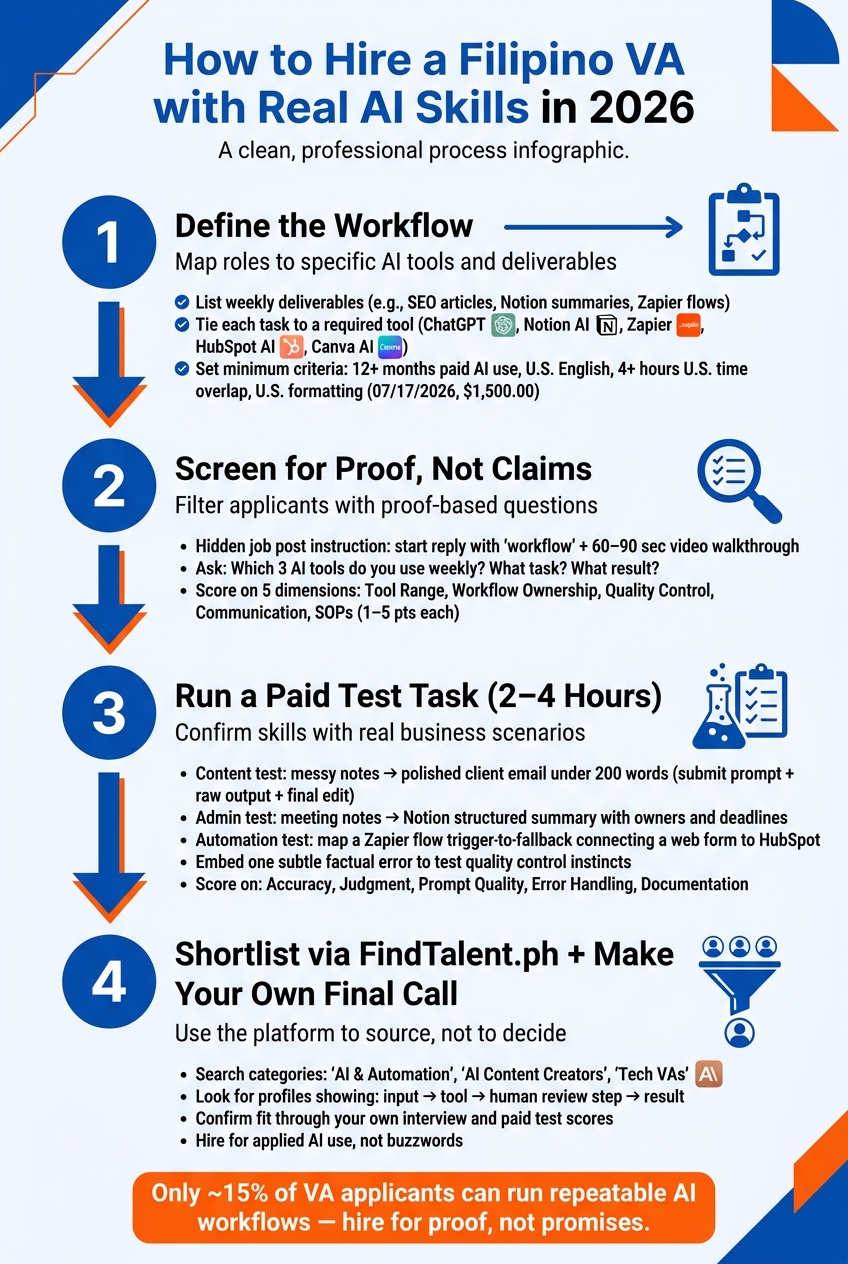
How to Hire a Filipino VA with Real AI Skills in 2026
How To Hire A Great Filipino Virtual Assistant (And Avoid Costly Mistakes)
sbb-itb-3690fed
Step 1: Define the VA role around specific AI workflows, not vague responsibilities
A vague “must know AI” line pulls in people who aren’t a fit. Instead, define the role around weekly workflows, then connect each workflow to a clear deliverable and tool. Do that before you write screening questions.
List specific deliverables and the exact tools tied to each task
Match each deliverable to the tool needed to do the job. When you name the tool in the job post, you set a clear standard for testing.
| Workflow | Deliverable | Required Tool |
|---|---|---|
| Content creation | Draft 5 SEO articles weekly from outlines, plus 3 social posts per article | ChatGPT, Claude, or Gemini |
| Research | Summarize competitor content, industry news, or source lists into structured Notion pages | Notion AI, Gemini |
| Meeting follow-up | Convert meeting notes into Notion tasks with owners and deadlines within 24 hours | Notion AI |
| Customer support | Draft first-response templates and escalation summaries for U.S. customer inquiries | ChatGPT or Claude |
| Lead capture | Build and maintain Zapier flows that route form leads to HubSpot with correct tags and pipeline stages | Zapier + HubSpot |
| Social graphics | Create branded carousel posts and social graphics from content briefs | Canva AI |
| CRM hygiene | Update contact records with AI-assisted call summaries and accurate deal stage tags | HubSpot AI |
When the role is mapped this way, each requirement becomes testable.
Separate basic AI use from end-to-end workflow ownership
Not every role calls for a VA who can rebuild your whole automation setup. But you do need to say which level you want.
- Basic AI use: follows your prompts and SOPs
- End-to-end workflow ownership: builds prompts, improves automations, checks outputs, and decides what is safe to publish
Say the ownership level plainly in the job post. A line like “You will own these AI workflows end-to-end, not just run prompts written by someone else” tells experienced candidates that you get the work. It also screens out people who don’t.
Set minimum hiring criteria that match U.S. operations
Set a floor of at least 12 months of weekly AI tool use on paid client work. Occasional personal use of ChatGPT doesn’t count.
Tool use alone isn’t enough. You should also require strong written English for U.S. audiences and at least 4 hours of overlap with U.S. business hours on weekdays. Add U.S. formatting standards too: dates like 07/17/2026, currency like $1,500.00, and units like miles, pounds, and Fahrenheit when needed. If a VA already works this way, you skip a correction cycle almost every time.
Use these as disqualifiers:
- no paid AI experience
- weak written English
- no U.S. formatting awareness
- not enough overlap hours
With the role defined this clearly, screening can focus on proof instead of claims. Next, turn these criteria into interview questions and paid tests.
Step 2: Build a screening process that filters out candidates who only claim AI experience
Once the role is clear, screen for proof, not claims. That means using a proof-based application and a depth-focused interview before you hand out any paid test. The goal is simple: find people who can show how they work, not just talk about it.
Add application questions that require proof of actual tool use
Start filtering before you even look at resumes.
A smart move here is to add a hidden instruction at the end of the job post: ask applicants to begin with the word workflow and include a 60- to 90-second unlisted video that walks through one AI-assisted task.
Then, in the structured part of the application, ask three direct questions:
- Which 3 AI tools do you use every week?
- What recurring task does each tool handle?
- What result did each workflow produce?
Strong answers get specific. They name the tools, explain how often they're used, and point to a clear result.
"I use Notion AI every Monday to convert raw meeting notes into structured task pages with owners and deadlines, which cut our follow-up time by about 3 hours per week."
Weak answers stay vague. Saying "I use ChatGPT and Canva for content" doesn't tell you much.
These responses help you decide who should move on to a deeper interview.
Ask interview questions that reveal workflow depth and judgment
Generic interview questions make it easy for polished candidates to glide by. Don't let that happen.
Ask them to walk through one prompt they wrote, how they structured it, and what they changed after the first output missed the mark. Ask how they check facts before sending AI-assisted content to a client. Ask what they do when ChatGPT, Claude, or Gemini gives a wrong answer with total confidence.
Data privacy also needs a direct question. Since 83% of Filipino AI users bring their own AI tools to work, you need to know where a candidate draws the line with client data. Ask what kinds of client information they would never place into a consumer AI tool. A strong candidate will separate public tools from approved systems and remove identifying details before prompting.
For automation roles, have them explain a Zapier flow they built or maintained from end to end. That includes the steps, the field mapping, and the first thing they check when a Zap breaks.
If the role leans toward Canva AI or HubSpot AI, ask for one specific campaign or support workflow they worked on. Have them explain the inputs, what they edited, and any result they can measure.
Watch for red flags and score candidates with a simple rubric
Some warning signs show up fast: vague claims, no specifics, no client-facing examples, and no clear process for checking outputs before they go out the door.
If someone says, "I use AI every day", but can't explain one workflow from start to finish, that's a surface-level user. Same if they hand over raw AI output with barely any editing. That's weak editorial judgment, and on client-facing work, that can turn into a mess.
To keep hiring decisions tied to evidence, score each candidate across five areas: tool range, workflow ownership, quality control, communication, and SOPs. Give 1 to 5 points in each category and only shortlist people who score well across all five.
| Dimension | What a Strong Score Looks Like |
|---|---|
| Tool range | Uses multiple relevant platforms, not just one |
| Workflow ownership | Manages tasks end-to-end, not just single steps |
| Quality control | Fact-checks, edits for tone, catches errors before delivery |
| Communication | Explains decisions and limitations clearly |
| SOPs | Creates process notes others can follow |
The candidates who clear this screen are the ones worth sending to paid test tasks. That’s where you check output quality, error handling, and documentation in practice.
Step 3: Use paid test tasks to confirm AI skills in real business scenarios
Once you've narrowed the list, run a paid trial to see how the person handles actual work. A 2–4 hour test is usually enough. Use a real workflow, set clear acceptance criteria, and test the same tools and deliverables you listed in the job post. Then look at three things: accuracy, usability, and review time.
Test content, research, and admin tasks with real inputs
A strong content test doesn't need to be fancy. Give the candidate messy notes and ask them to use ChatGPT, Claude, or Gemini to turn those notes into a client email under 200 words with a professional, warm, and concise tone.
Ask them to submit:
- The prompt they used
- The raw AI output
- The final edited version
That gap between the first draft and the finished version tells you a lot. It shows whether they can think like an editor instead of just pasting whatever the model gives them.
For admin work, hand over a messy set of meeting notes and ask them to use Notion AI to turn it into a structured summary with decisions, action items, owners, and deadlines. Good candidates won't just clean things up. They'll also point out what's unclear or missing in the source notes instead of guessing.
Test automation, customer support, and lead management workflows
For ops roles, test the same handoff and follow-up flows your team uses every day. Ask the candidate to map a Zapier workflow from trigger to fallback step that connects a web form submission to an email notification and a HubSpot pipeline stage update. They should explain what starts the automation, what each step does, and what they'd check first if the Zap stopped working.
Customer support tests should cover both routine and sensitive cases. Give them three realistic customer emails and ask for AI-assisted replies that match your brand tone. A good candidate will reshape the AI draft in a meaningful way and flag any message that should be escalated instead of answered on autopilot.
For lead management, provide a sample lead record with missing fields and ask them to update the stage, add notes, and write a follow-up reminder. Then check one simple thing: is the output clean enough to hand off right away?
Score output quality, error handling, and process documentation
One of the best tests is also one of the simplest: add one subtle factual error to the source material and see what happens. A weak candidate will pass it along without a second look. A solid VA will flag it, fix it, or note that it needs checking before it reaches a client.
Use the same rubric for every candidate so you're comparing apples to apples:
| Scoring Category | What Strong Output Looks Like | Red Flag |
|---|---|---|
| Accuracy | Facts, names, and instructions are correct; errors are caught | AI output accepted without verification |
| Judgment | Output is improved beyond the first AI draft; issues are flagged proactively | Generic, lightly edited AI text delivered as final |
| Prompt quality | Uses structured prompts and the right tool for the task | One-sentence prompts; same tool used for everything |
| Error handling | Edge cases and fallback steps are noted for automation tasks | Process breaks or stops when something unexpected happens |
| Documentation | Steps are clear enough for another team member to repeat the task | "Black box" process only the VA understands |
Put business usefulness ahead of polish. A response doesn't need to sound pretty if it creates more cleanup for your team. Use the scores to rank candidates, then shortlist the strongest ones through FindTalent.ph.
Step 4: Shortlist and hire through FindTalent.ph alongside your own screening process
Once your rubric and paid test are ready, use FindTalent.ph to source candidates who already show proof of AI workflow use. It can help you find Filipino VAs faster. But it should be a sourcing and pre-screening layer, not your final hiring decision.
Use FindTalent.ph to find Filipino VAs with documented AI skills
On FindTalent.ph, look for profiles with visible work history and tool-specific examples in categories like "AI & Automation", "AI Content Creators", and "Tech VAs." You want profiles that name the exact tools used and show a finished workflow.
The main signal is workflow specificity.
A strong profile might say the person used Claude to draft support replies, then checked those replies for policy accuracy before sending. Or it might show a Zapier workflow that routes form submissions into HubSpot pipeline updates. That tells you how the person works.
A weak profile is much thinner. It says only that the candidate is an "AI tool user" or is familiar with modern tools. That sounds nice, but it doesn't tell you much.
Look for proof of prompt quality, editing, and quality control. In work like content drafting, research, admin support, customer support, and lead management, strong profiles explain the full workflow:
- the input
- the tool
- the human review step
- the result
Treat the profile as a piece of evidence of workflow ownership, not proof that the person is ready to hire. The profile should point to the same kind of proof your test will later confirm.
Pair FindTalent.ph profiles with your own interview and test process
Use FindTalent.ph to build a shortlist, then confirm fit through your own interview and paid test. Let profile details help you decide who gets an interview. Then score each person with the same standards you set in Step 2 and Step 3.
Ask for:
- one recent client workflow
- one prompt example
- one case where the AI output was wrong
That gives you a clearer read on whether the candidate can work inside U.S.-style workflows, communicate clearly, and use AI with care.
Hire for applied AI use, not theory. Use the platform to narrow the pool. Use your interview and test to make the final call.
Conclusion: Hire for proof of workflow ownership, not AI buzzwords
In 2026, the main question isn’t whether a Filipino VA has tried AI tools. It’s whether they can use those tools to run repeatable weekly workflows. That’s the line between simple tool use and actual workflow ownership.
The hiring rule is straightforward: if a candidate can’t show how they use AI in real weekly work, they’re not ready for a role that depends on AI-assisted output. That becomes your filter. Ask for clear proof of weekly use, like:
- a screenshot
- a short Loom walkthrough
- a sample prompt
- a before-and-after example
Then check that proof in a structured interview and a paid test before you hire.
Use FindTalent.ph to shortlist Filipino prompt engineers with documented AI workflow experience, then confirm fit through your interview process and paid test. If they can prove it in a test, they’re ready to work.
Hire for proof of repeatable output, not AI buzzwords.
FAQs
How can I verify real AI workflow experience?
Don’t take self-reported claims at face value. Ask for proof instead: a workflow diagram, a walkthrough of an AI-enabled process they built, or a look at how they edit AI-generated content.
A short test task can tell you a lot. It should show whether they can explain:
- why they picked certain tools
- how they write prompts
- what fallback logic they use
- how they fact-check output
- how they test edge cases
- how they track reliability and token costs
That way, you’re not just hearing what they say they can do. You’re seeing how they think and how they work under normal conditions.
What should I include in a paid VA test?
Include a task that mirrors the VA’s day-to-day work. That could mean drafting a blog post, cleaning a spreadsheet, or setting up a simple automation. The point is to see them use AI on the job, not just talk about it in the abstract.
Look at how well they handle the tools you care about, how carefully they review outputs for mistakes or made-up claims, and how clearly they document what they did. You can also ask how they’d use Zapier, ChatGPT, or Notion AI to cut down time spent on a repetitive process.
What red flags suggest a candidate only knows AI basics?
Watch for candidates who lean on a single AI tool for every job instead of working across a broader stack. That can be a red flag.
Another warning sign: taking AI output at face value without checking brand voice, factual accuracy, or hallucinations. If someone treats the first draft like it's done, that's a problem.
Be careful with people who just copy and paste AI content, too. Stronger candidates do more than that. They show prompt engineering skills and know how to use system prompts and chain-of-thought instructions to get more consistent, higher-quality results.