Business Operations
How to Pay a Virtual Assistant in the Philippines: Wise, Payroll, Contracts, and Taxes (2026)
Classify your Philippine VA correctly — use Wise for contractor invoices and payroll/EOR for employee-like roles to avoid tax and compliance risk.
12 min read
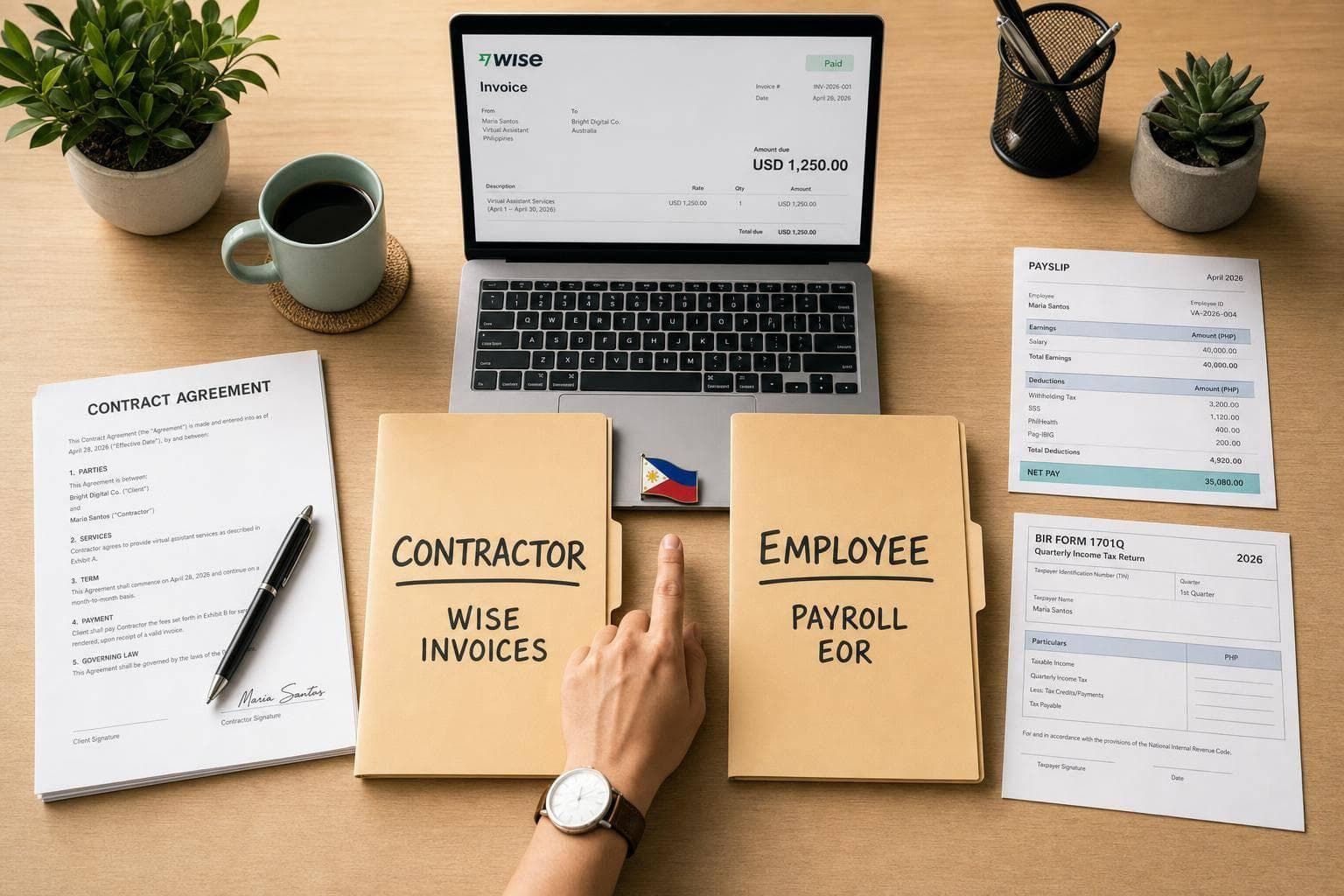
If you pay a Philippine VA from the U.S., start with one question: contractor or employee? That choice affects how you pay, whether you need payroll, which tax form to collect, and how much paperwork you keep.
Here’s the short answer:
- If the VA works independently, sends invoices, and controls how the work gets done (like an operations virtual assistant), I’d usually treat them as a contractor and pay through Wise or bank transfer.
- If the VA works fixed hours, only works for you, and is managed like staff, I’d look at payroll or an EOR instead.
- For contractor payments, Wise is often the simplest option, with fees around 0.57% - about $5.70 on $1,000 - while bank wires often cost more and can take 3 to 5 business days.
- Before the first payment, I’d collect a contract, payment details, invoice process, and a signed Form W-8BEN.
- In most cases, a Philippine contractor doing the work in the Philippines is not reported on Form 1099-NEC, and U.S. withholding usually does not apply if the W-8BEN is on file.
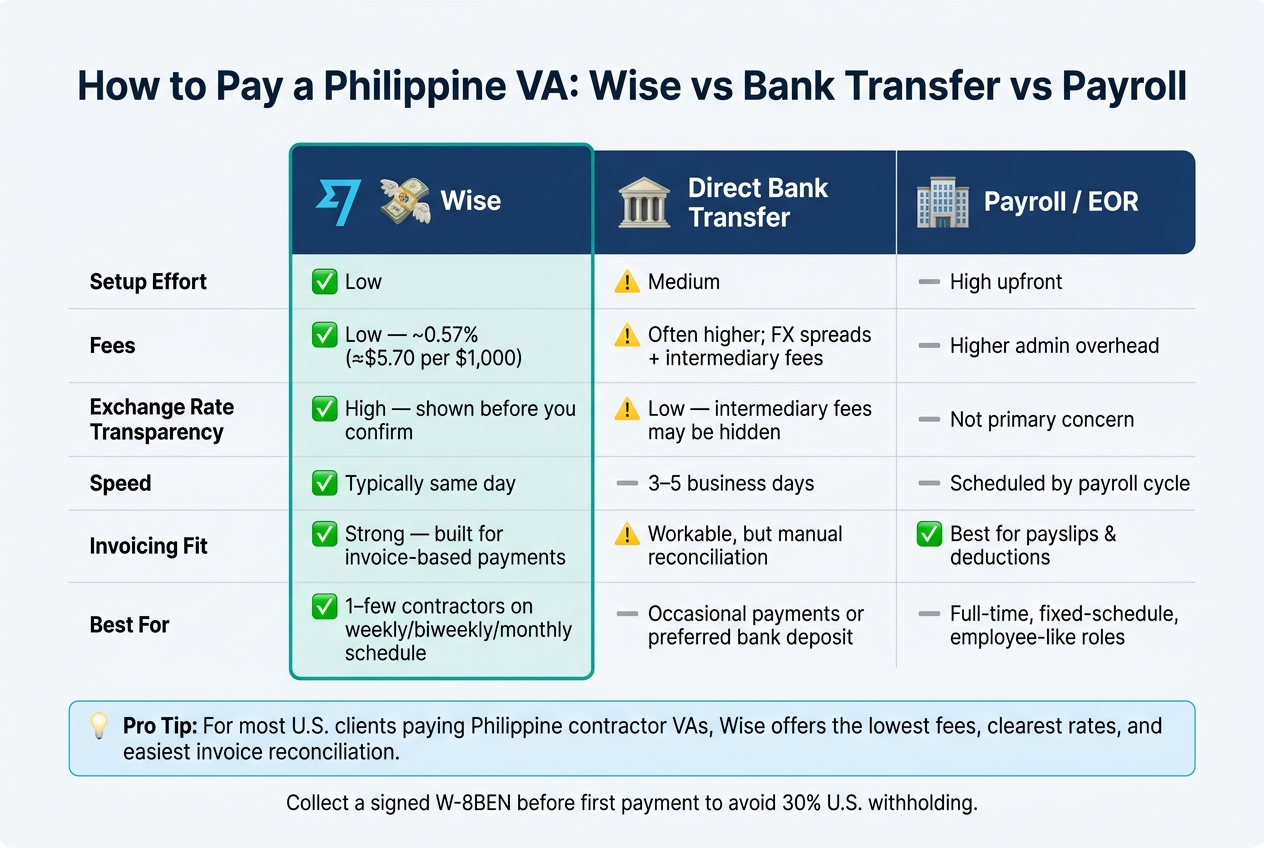
How to Pay a Philippine VA: Wise vs Bank Transfer vs Payroll
How to pay Virtual Assistants from the Philippines | Practical advice and HOURLY RATES
sbb-itb-3690fed
Quick comparison
| Option | Best for | Cost | Speed | Admin |
|---|---|---|---|---|
| Wise | Paying contractor VAs by invoice | Low; about 0.57% in the article example | Often same day | Low |
| Bank transfer | When direct deposit is preferred | Often higher; FX and bank fees may apply | Often 3–5 business days | Medium |
| Payroll / EOR | Employee-like roles | Higher than single transfers | Based on payroll cycle | High setup, less manual work later |
I’d keep the process simple: classify the role, choose one payment method, set terms in writing, collect invoices, and save every payment record. That gives you a clean setup without adding extra friction.
1. Confirm the working relationship before sending any payment
Start by figuring out the relationship first. That one call affects how you pay, how taxes are handled, and what rules apply. Many Filipino VAs working with U.S. companies are treated as contractors, but what matters is the actual setup. After that’s clear, you can pick the payment method that matches it.
Independent contractor vs employee: what changes for payment and compliance
Philippine law focuses on how the work is controlled in practice, not just what the contract says.
A VA who chooses their own hours, uses their own equipment, works with more than one client, and is judged by output usually fits the contractor model. A VA who follows fixed hours, works only inside your systems, is limited to one client, and is watched closely on how the work gets done looks much more like an employee - even if the contract labels them a contractor.
| Signal | Points to Contractor | Points to Employee |
|---|---|---|
| Schedule | VA sets their own hours | Client sets fixed daily hours |
| Exclusivity | Can work for multiple clients | Restricted to one client only |
| Tools | Uses their own equipment | Uses client tools |
| Supervision | Measured by deliverables | Closely monitored on process and activity |
| Payment structure | Paid by invoice | Regular salary-style pay |
If the arrangement is plainly contractor-based, invoice-led cross-border transfers usually make the most sense. If the setup starts looking like employment - fixed hours, exclusivity, and close day-to-day oversight - then payroll or an Employer of Record setup is a better fit. That also means handling Philippine statutory remittances such as SSS, PhilHealth, and Pag-IBIG.
What U.S. clients typically need to collect from a Philippine VA
Once contractor status is confirmed, collect these four items before the first payment goes out:
- Signed contractor agreement confirming contractor status.
- Payment details - the VA’s Wise email, bank account number, or other transfer information.
- Invoices - ask for one invoice per pay cycle and keep each one on file.
- IRS Form W-8BEN - a Filipino VA working from the Philippines must complete and sign this form to certify non-U.S. status.
That last item matters a lot. Without a valid W-8BEN, U.S. withholding rules may require you to hold back up to 30% of each payment.
With a valid W-8BEN in place, and with the services performed in the Philippines, U.S. withholding usually does not apply. You also do not issue Form 1099-NEC. The VA handles their own Philippine tax filings. On your side, keep the contract, invoices, payment confirmations, and W-8BEN on file. If the IRS ever asks, those records help support your expense deductions and show why the worker was treated as a contractor.
With classification settled, the next step is choosing whether Wise, a bank transfer, or payroll is the cleanest way to pay.
2. Choose the right payment method: Wise, direct transfer, or payroll

Once you've sorted out the working relationship, the next step is picking the payment rail that fits it.
The simple version looks like this: use Wise for most contractor payments, use direct bank transfer when a plain deposit is easier, and use payroll when the role starts to look more like employment.
Using Wise for contractor payments
For most founders and small businesses paying one or a few Philippine VAs, Wise is usually the best option.
It’s built for international contractor payments, and it shows the fee and exchange rate before you send. That makes the whole process easier to plan around, especially if you pay on a weekly, biweekly, or monthly invoice cycle. There’s less guesswork, which matters when you’re trying to keep books clean and avoid back-and-forth.
A small habit helps here: include the invoice number in the transfer reference. It makes reconciliation much easier later.
When payroll makes more sense than individual transfers
Payroll starts to make more sense when the setup is employee-like instead of contractor-like.
That usually means things like:
- fixed hours
- fixed recurring duties
- a team working on a set cadence , such as HR virtual assistants managing internal processes
In that case, a payroll service or Employer of Record can handle pay runs, payslips, and deductions. Yes, payroll comes with more setup and more admin than sending individual transfers. But if compliance risk is on your mind, that extra work can be worth it.
Comparison table: Wise vs direct bank transfer vs payroll
Direct bank transfer can still work. The tradeoff is that fees and FX costs are often less clear, and reconciliation usually takes more manual work. It tends to fit best when a bank deposit is simply easiest for both sides, or when your current banking setup keeps costs in check.
| Method | Setup effort | Fees | Exchange rate transparency | Speed | Invoicing fit | Best use case |
|---|---|---|---|---|---|---|
| Wise | Low | Low, explicit fees | High; shown before you confirm | Typically predictable | Strong; supports invoice-based contractor payments | One or a few contractors on a weekly, biweekly, or monthly schedule |
| Direct bank transfer | Medium | Often higher and harder to see upfront | Lower; intermediary fees and FX spreads may not be visible | Mixed; can be slower and less predictable | Workable, but reconciliation is more manual | Occasional payments or when bank deposit is preferred |
| Payroll / EOR | High upfront, with ongoing admin handled through the provider | Higher admin overhead than individual transfers | Not the main issue; designed for structured pay runs | Scheduled by payroll cycle | Best for formal employment with payslips and deductions | Full-time, fixed-schedule, employee-like roles |
Once you choose the payment rail, put those terms into the contract so the method, cadence, and invoicing stay consistent.
3. Put the payment terms into a clear VA contract
Once you choose Wise, bank transfer, or payroll, put those terms in writing. Your contract should lock in payment terms, contractor status, and tax responsibility.
What to include: scope, rate, pay schedule, currency, and payment method
Be specific about the work, rate, pay schedule, currency, and payment method.
For scope, spell out what the VA is expected to do in measurable terms. For example, you might say they must respond to emails within 24 hours. That removes guesswork and gives both sides a clear standard.
For pay, state whether the arrangement is:
- Hourly
- A monthly retainer
- Per project
- Milestone-based
Then add the billing cadence, invoice deadline, approval window, and the date funds are sent. Net 15 or Net 30 works well in many cases. It also helps to add a short grace period and note that work may be paused if invoices remain unpaid.
Currency needs the same level of detail. If you pay in USD through Wise to a Philippine bank account, say who pays transfer fees and who covers local bank charges or exchange-rate differences. Also name the exact payment method in the contract, such as Wise, bank transfer, or payroll.
Contract language for contractor status, invoicing, and tax responsibility
The contract should state that the VA is an independent contractor, controls how the work is done, and does not receive employee benefits.
It should also confirm that the VA is self-employed and provides services as long as deadlines and deliverables are met. That wording matters. It helps set the working relationship from day one and cuts down on confusion later.
Once contractor status is clear, explain how invoices are submitted and approved. The agreement should also say that the VA handles their own Philippine tax registration and filings, and that the U.S. client does not withhold Philippine taxes. This gives each side a clear lane and helps avoid payment disputes.
For invoicing, require:
- The VA’s legal name
- Tax identification number, if available
- Invoice number
- Billing period
- Rate
- Total amount due
- Currency
- A breakdown of hours or deliverables
Ask for an invoice or official receipt that matches the pay period, amount, and currency.
Using FindTalent.ph to set clear hiring and payment expectations

FindTalent.ph profiles can help both sides line up on rates, hours, and payment cadence before the contract is signed. That makes invoicing and recordkeeping much simpler from the first payment.
With the contract set, invoices and records become much easier to handle.
4. Handle invoices, taxes, and recordkeeping correctly
Once the contract sets the rate and payment method, the process is pretty straightforward: receive the invoice, check it, pay it, and save the record. A set workflow keeps payments, tax files, and reconciliation tidy.
How Philippine VAs typically invoice foreign clients
Once the payment method is in place, the invoice should match the agreed currency and billing cycle. Many Filipino VAs register with the BIR, get a TIN and Certificate of Registration, and issue BIR-registered invoices for each payment, including payments from overseas. Match the invoice currency and payment instructions to the method you picked earlier. For services, Philippine providers generally issue invoices.
For U.S. clients, the VA will often send a PDF invoice in English and USD. A complete invoice should include:
- The VA's full name and address
- The client's name and billing address
- A unique sequential invoice number
- The invoice date and due date
- The service period
- A description of the work performed
- The rate and hours
- The total amount due in USD
- Payment instructions for Wise or bank transfer
Billing in USD helps avoid disputes tied to exchange-rate swings between the invoice date and the payment date. It keeps things simple, which is half the battle.
Who handles taxes: Philippine VA obligations and U.S. client responsibilities
Tax responsibility usually follows where the work is done. The VA handles Philippine tax filings, while the U.S. client keeps foreign-contractor records.
The Philippine VA handles their own tax duties: registering with the BIR, filing quarterly income tax returns on BIR Form 1701Q due April 15, August 15, and November 15, and filing an annual return on BIR Form 1701 or 1701A by April 15 of the next year. They also need to issue compliant invoices for all income received. That still applies when the client is in the U.S. and pays in U.S. dollars.
U.S. clients usually do not owe Form 1099-NEC reporting or withholding for services performed entirely in the Philippines. Keep contracts, invoices, and payment confirmations on file for bookkeeping and expense support. For your own setup, check with a U.S. tax professional.
Common mistakes to avoid when paying Filipino VAs
Once the tax side is clear, the last piece is solid recordkeeping. The costliest mistake is paying without a written contract. If there is no contract, there is no agreed rate, no defined currency, and no clear contractor status. Over time, that can create worker-classification risk if the setup starts to look more like employment.
Another common problem is not stating whether the rate is fixed in USD or converted from PHP. If the contract fixes the rate in USD, spell out who covers FX differences when payment is sent in PHP. If the peso moves and the contract is fuzzy, it's easy for both sides to argue over the amount paid.
Other mistakes are more basic, but they still cause headaches: not collecting invoices, paying from chat messages alone, and failing to store payment confirmations with the matching invoices. U.S. businesses generally keep support records for at least 7 years to cover typical IRS audit windows.
A simple monthly checklist can keep this under control:
- Confirm the contract terms
- Verify the invoice
- Send payment
- Log the transaction ID
- Save the invoice and payment confirmation in the VA's accounting folder
Conclusion: Build a simple, repeatable payment workflow
Once the contract and payment method are in place, the last step is making the process repeatable. Stick with the relationship type you already set: contractor for independent, deliverable-based work; payroll or EOR for roles that look more like employment.
For contractor payments, standardize on Wise, lock in the USD rate and pay date, and use the same payee details each cycle. When you run one payment rail and one pay date, everything else comes down to paperwork.
The workflow is simple: classify the relationship, set payment terms, invoice on schedule, pay through one channel, and file the records together.
As you hire Filipino general virtual assistants and your team grows, keep using the same contract template, invoice format, and pay date. The smoothest systems are documented once and followed the same way each time - fewer disputes, cleaner books, and lower compliance risk. Pick one method, document it once, and use it every month.
FAQs
How do I know if my VA is truly a contractor?
Your VA is generally an employee, not a contractor, if you're the one providing Philippine statutory benefits like SSS, PhilHealth, Pag-IBIG, and 13th-month pay.
Why? Because contractors usually work as independent service providers. They handle their own admin, taxes, and required contributions.
To make the relationship clear, your contract should spell out:
- the role
- pay terms
- employment status
- whether you're taking on employer duties under Philippine labor law
That wording matters. If you're covering employer-required benefits, the setup often points to an employer-employee relationship, not an independent contractor arrangement.
When should I use payroll instead of Wise?
Use a payroll service when your virtual assistant is a direct employee, not an independent contractor.
In the Philippines, that means you’re on the hook for SSS, PhilHealth, Pag-IBIG, and 13th-month pay. A payroll service can take care of much of that admin work by handling compliance tasks, tax deductions, and filings that Wise doesn’t manage.
If your team is stretched thin, this can save time and cut down on mistakes. The trade-off is cost: payroll services often add about 20% to 25% on top of base salary.
What records should I keep for tax and compliance?
Keep a signed contractor agreement that spells out the scope of work, pay terms, intellectual property, confidentiality, and notice periods.
You should also keep invoices and payment records from tools like Wise or Payoneer. If the VA is a direct employee, hold on to records that show compliance with Philippine labor laws, including SSS, PhilHealth, and Pag-IBIG contributions. If you use an Employer of Record, that provider will usually handle this paperwork.