Remote Work
50+ Outsourcing Statistics for 2026: Philippines and Global Remote Work Data
Offshore hiring grows in 2026—Philippines leads with lower costs, fast hiring, 1.9M BPO workers, and rising AI/tech talent.
9 min read

If you want the short answer: offshore remote hiring is still growing, and the Philippines remains one of the top places to hire in 2026. I see the main draw as simple: lower cost, fast hiring, English-first support work, and solid coverage for U.S. time zones.
Here’s the article in plain English:
- Outsourcing = paying another company or person to do the work
- Offshoring = moving that work to another country
- Remote work = the work happens outside a normal office
In 2026, companies often use all three at once.
The numbers in this article point to a few clear takeaways:
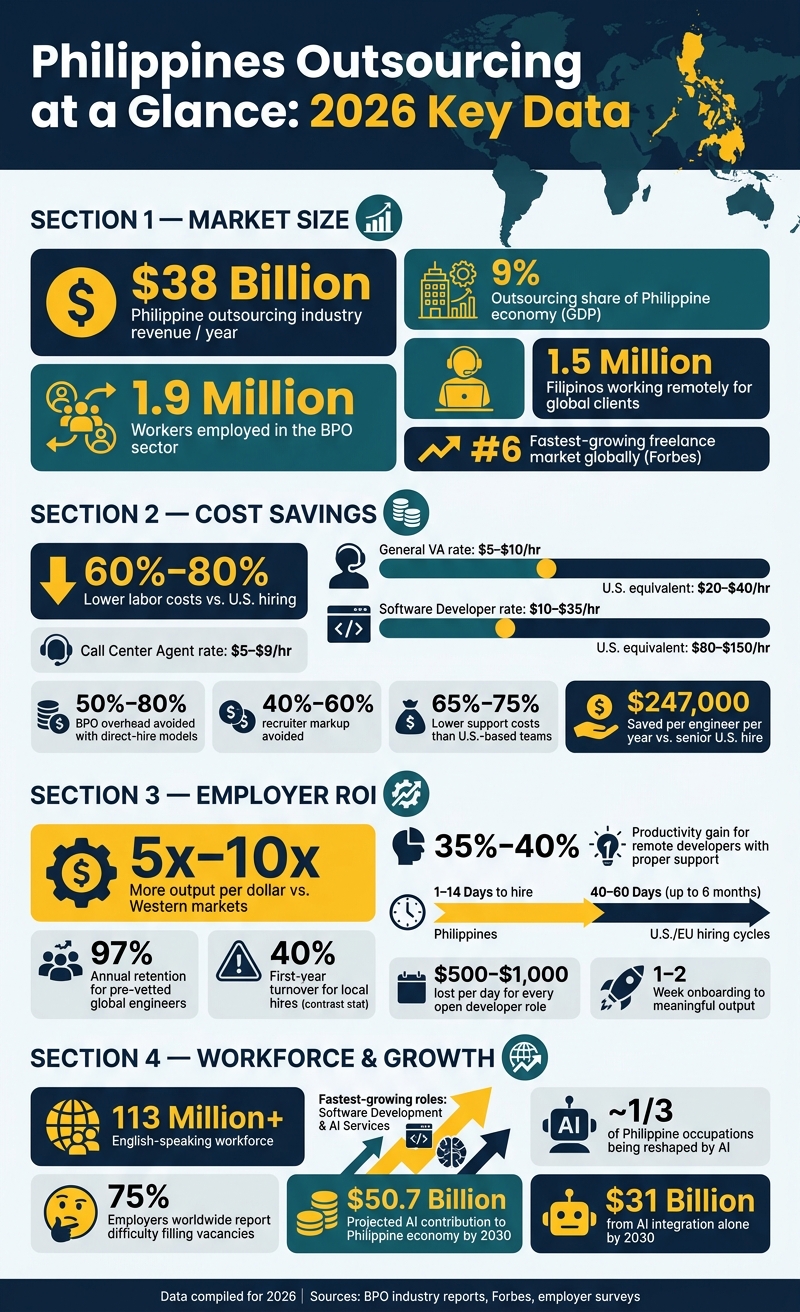
- The Philippine outsourcing industry brings in about $38 billion a year
- It accounts for close to 9% of GDP
- The BPO sector employs about 1.9 million workers
- Around 1.5 million Filipinos work remotely for overseas clients
- Hiring in the Philippines can cost 60% to 80% less than hiring in the U.S.
- Direct-hire remote setups can cut out 50% to 80% BPO overhead and 40% to 60% recruiter markup
- Remote hiring is moving past admin and support work into software, automation, AI workflows, and chatbot work
- Employers are dealing with talent gaps, with 75% saying roles are hard to fill
- Open developer roles can cost about $500 to $1,000 per day
- Some remote hires can start in 1 to 14 days, far shorter than many local hiring cycles
What matters most to me is that this is no longer just a cost story. The article also points to retention, output per dollar, overnight shift coverage, and AI tool skills as key parts of the hiring decision.
Philippines Outsourcing Statistics 2026: Cost, ROI & Workforce Data
PH business process outsourcing industry hits record $40-B revenue in 2025 | ANC
sbb-itb-3690fed
Quick Comparison
| Area | What the data shows |
|---|---|
| Market size | Philippines outsourcing brings in $38 billion/year |
| Talent pool | BPO workforce at about 1.9 million |
| Remote supply | About 1.5 million Filipinos work for global clients |
| Cost | Often 60%–80% lower than U.S. hiring |
| Fast-growth roles | Software development and AI-related services |
| Hiring speed | Some roles filled in 1–14 days |
| Main employer gains | Lower spend, less vacancy loss, better retention, 24/7 coverage |
If you’re hiring in 2026, I’d read this article as a benchmark piece: it helps you compare cost, role fit, hiring speed, and ROI before choosing between local hires, agencies, or direct offshore remote talent.
1. Market Size
These numbers make one thing pretty clear: offshore hiring and remote delivery are still growing in 2026. The market is big, and the room for growth is even bigger.
Here are 12 stats that show where the scale is today and where employers are finding room to grow.
- The Philippine BPO sector employs roughly 1.9 million workers
- Over 1 million agents work in call center roles across Manila, Cebu, and Davao
- Customer support and administrative work remain the largest outsourcing service segments
Demand is still highest in these areas, even as more companies move into specialized technical work.
- Software development and AI-related services are the fastest-growing outsourcing categories
Specialists in automation, chatbot development, and AI workflow integration are seeing more demand.
- The Philippines is the sixth-fastest-growing freelance market globally
That growth makes sense. The country's English proficiency and familiarity with Western business tools give it a strong edge.
- AI could add up to $50.7 billion to the Philippine economy by 2030, including $31 billion from AI integration alone
- Approximately one-third of all occupations in the Philippines are currently being reshaped by AI
- The Luzon Economic Corridor is attracting investment in AI and supply chain sectors
- 75% of employers worldwide report difficulty filling vacancies
- Unfilled developer positions can cost businesses between $500 and $1,000 per day
That kind of cost adds up fast, which helps explain why more teams are looking offshore.
- Traditional BPO providers typically add a 50% to 80% markup to agent wages
That pricing gap is a big reason many employers are moving toward direct-hire remote models.
- The Philippines is ranked among the top offshore destinations for English-language talent and Western-aligned work culture
These same market shifts also affect where employers are likely to find remote talent next.
2. Remote Workforce
In 2026, remote hiring is judged on supply, speed, and output - not just cost. If market size points to demand, this section looks at who can actually do the work.
Here are 10 stats that show where the global remote workforce stands right now.
- Filipino remote workers routinely cover overnight shifts aligned to U.S., U.K., and Australian hours
Two decades of BPO night-shift culture have made client-aligned overnight schedules a normal part of work.
- Employers report 5x to 10x more output per dollar when hiring Filipino talent versus Western markets
- The Philippines has a workforce of more than 113 million, with English widely used in business and education
- Demand for remote workers fluent in automation tools like Zapier, Make, and OpenAI APIs is rising
- Employers now prioritize AI-enhanced portfolios over job titles alone
A job title can say one thing. A portfolio that shows workflows, prompts, automations, and shipped work says a lot more.
- Small and mid-sized businesses are increasingly moving away from traditional job boards because of ghosting and unverified skills
- AI-matched hiring platforms can shortlist verified candidates in minutes, not weeks
For hiring teams, that changes the game. Instead of sorting through piles of resumes, they can move straight to a smaller pool of people who already meet the bar.
- Employers now screen for proactive communication: flagging issues before they escalate
Proficiency in async tools like Loom, Slack, and Asana has become a baseline hiring criterion.
- Monthly retainers range from about $800 for entry-level admin roles to $6,000+ for senior technical roles
| Role | Philippines Rate |
|---|---|
| General VA | $5–$10/hr |
| Specialized/Technical VA | $10–$18/hr |
| Software Developer | $10–$35/hr |
| Call Center Agent | $5–$9/hr |
Next, the Philippines benchmarks show how these rates translate into role fit, hiring speed, and team structure.
3. Philippines Benchmarks
The Philippines is a mature outsourcing hub with proven infrastructure and $38 billion in annual industry revenue, accounting for nearly 9% of GDP. For employers, that scale shows up in a labor market that can handle volume, supports English-first work, and fits well with U.S. teams.
The numbers help make that concrete.
- The BPO sector employs approximately 1.9 million workers.
- Forbes ranks the Philippines as the 6th fastest-growing freelance market in the world.
- General VAs cost $5–General VAs cost $5–$15/hr5/hr - about 60–75% below U.S. rates of $20–$40/hr.
- Call center agents cost $5–$9/hr, and coverage during U.S. business hours is standard.
- A senior full-stack developer in Manila can cost less than a junior developer in San Francisco.
- Tech VAs who specialize in no-code tools like Zapier, Make, and HubSpot earn $7–$15/hr and are seeing more demand.
Cost is only part of the picture. Day-to-day reliability matters too, especially for remote teams that need steady output and clean handoffs.
- Most remote workers maintain a dedicated workspace with broadband and a backup mobile data connection to ensure reliability.
- A strong university pipeline produces graduates in tech, healthcare, and business.
4. Employer ROI
Hiring data from the Philippines points to measurable ROI, not just lower hourly rates. Filipino professionals are estimated to deliver 5–10x more output per dollar. And pre-vetted global engineers show 97% annual retention, compared with 40% first-year turnover for local hires.
That starts to matter fast when employers track the numbers that hit the business hardest: cost per hire, retention, and output.
- Up to 80% lower labor costs - Filipino specialists often charge $5–$15/hour versus $80–$150/hour for similar Western roles.
- $247,000 saved per engineer each year - That estimate includes salary, benefits, and overhead compared with a senior U.S.-based hire.
- 5–10x more output per dollar - A stronger return when performance is measured by cost per deliverable.
- 97% retention for pre-vetted global engineers vs. 40% first-year turnover for local hires.
- 35%–40% productivity gain - Remote developers with the right support outperform office-based peers by 35%–40%.
- Hire in 1–14 days - Much faster than the 40–60 days, and sometimes up to 6 months, tied to standard U.S. or European hiring cycles.
- $500–$1,000 lost per day - That’s the direct and indirect cost of leaving a developer role open.
- 50%–80% overhead avoided - Old-school BPO setups can add that much in overhead and management fees.
- 40%–60% agency markup avoided - Direct-hire models cut out the recruiter commission layer that inflates many staffing deals.
- 65%–75% lower support costs than U.S.-based teams.
- One- to two-week onboarding - A remote Filipino developer with the right tech stack can reach meaningful output in that time frame.
- 24/7 coverage without shift premiums - Graveyard shifts are common in the Philippines, which helps companies run around the clock without the added pay often tied to U.S.-based night staff.
- Sourcing and screening start at about $600 as a one-time cost, which lowers upfront hiring friction.
- $31 billion AI economic boost by 2030 - That growth is pushing demand for AI and automation roles like prompt engineering and chatbot development in the Philippines.
Put simply, these numbers show where the payoff comes from: lower hiring costs, faster ramp-up, better retention, and less money leaking into markups and overhead.
Key Takeaways for Employers and Recruiters
The data points to a clear pattern: outsourcing to the Philippines gives employers scale, lower cost, and more room to run. The big question is where those gains show up in hiring.
The Philippines brings in about $38 billion per year from outsourcing, or nearly 9% of GDP, while labor costs are 60% to 80% lower than in Western markets. That gap matters, of course. But cost isn't the whole story. Day-to-day dependability matters just as much.
For U.S. employers, the Philippines offers a 113M+ English-speaking workforce, shift flexibility shaped by the BPO industry, and strong working knowledge of tools like Slack, Asana, and Google Workspace. In plain English, that means faster onboarding, smoother coordination, and steady 24/7 coverage without the extra cost of shift premiums.
The fastest-growing roles in 2026 are in software development and AI services, including AI automation and chatbot work. At the same time, about one-third of Philippine occupations are being reshaped by AI integration. So when you screen candidates, look past surface-level tool knowledge. Focus on people who have shipped automations, built integrations, or worked on chatbot projects.
For hiring teams, the takeaway is simple: use direct-hire models and a short paid trial with weekly deliverables. It cuts overhead, speeds up evaluation, and improves the odds of long-term retention. Hire for output, not credentials alone.
FAQs
Which roles are best to outsource to the Philippines?
The Philippines is a strong fit for outsourced roles that call for solid English, dependable day-to-day work, and close alignment with U.S. business norms.
Common choices include:
- customer service and administrative support
- bookkeeping, HR, recruiting, and sales support
- content, digital marketing, and design
- technical roles like AI automation, Shopify management, web development, and CRM administration
How do direct-hire remote teams compare with BPO setups?
Direct hiring gives you access to the same BPO-trained talent pool, but without agency markups, seat fees, or long-term contract lock-ins.
That price gap can be big. BPO contracts often bundle in account management and overhead, which can add 50% to 80% on top of an agent’s base wage. With a direct-hire model, you pay the specialist directly instead.
For teams with fewer than 10 agents, this setup is often the lower-cost option. The catch is simple: you handle the work yourself. That means taking care of onboarding, training, and performance monitoring in-house.
What should I check before hiring remotely in the Philippines?
Check the candidate’s setup before you hire. Look at internet stability, backup power, and how clearly they communicate. That matters even more outside Metro Manila and Cebu, where outages and connection issues can be more common.
If you’re hiring someone as an employee, plan for SSS, PhilHealth, Pag-IBIG, and 13th-month pay. Those costs can add 20–25% on top of base salary. To lower risk, start with a trial project or part-time arrangement, set clear SOPs, and ask for proof of past work, like portfolios or case studies.