Business Operations
Remote Hiring Checklist: 15 Steps to Find Top Talent
15-step checklist to hire and onboard Filipino remote professionals, covering role definition, sourcing, legal pay, and onboarding.
12 min read

Hiring remote talent can feel overwhelming, but a clear checklist simplifies the process. This guide outlines 15 actionable steps to streamline hiring Filipino professionals for U.S.-based teams, from defining roles to onboarding.
Key Highlights:
- Why the Philippines? Skilled, English-proficient workforce with cost savings of 50–66% compared to U.S. hires.
- Salary Ranges: Virtual Assistants ($500–$800/month), Web Developers ($1,000–$2,500/month), and more.
- Legal Must-Knows: Include 13th-month pay and employer contributions to mandatory benefits.
- Efficient Tools: Use platforms like FindTalent.ph for AI-driven candidate sourcing and pre-screened talent.
- Structured Process: Role scorecards, trial tasks, and standardized interviews ensure fair evaluations.
Pro Tip: A well-planned onboarding process boosts retention by 82% and productivity by 70%. Start with a 30-60-90 day plan and daily check-ins during the first week.
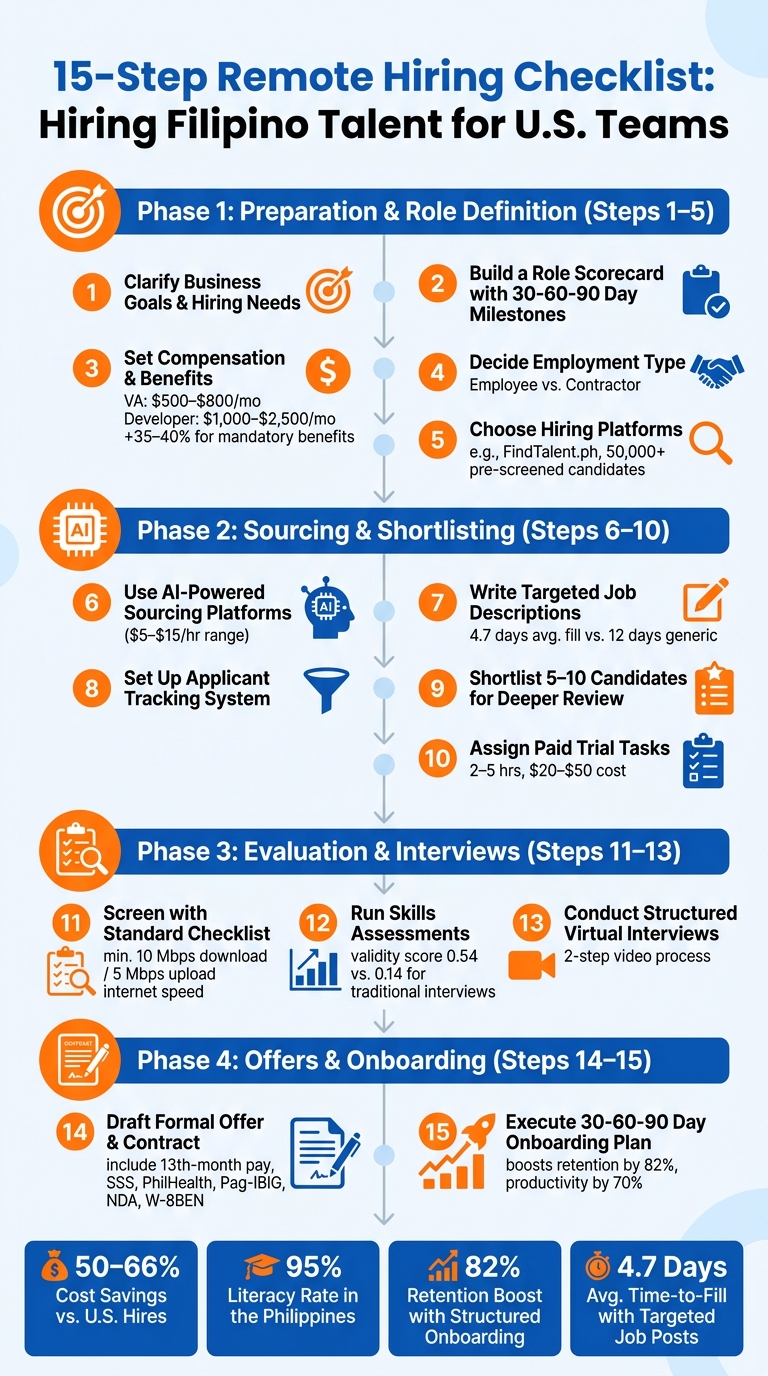
15-Step Remote Hiring Checklist for Filipino Talent
What Everyone Gets Wrong About Filipino Remote Workers
sbb-itb-3690fed
Steps 1–5: Preparation and Role Definition
Getting the basics right in defining roles is critical for a smooth remote hiring process. Skipping this step can lead to costly mistakes down the line.
Step 1: Clarify Your Business Goals and Hiring Needs
Ask yourself: What specific problem will this hire address? Determine whether you need full-time, part-time, or contract help, and identify any necessary time zone overlaps. Clearly outline the tools your team uses (like Slack, HubSpot, or Notion) and set response-time expectations. For example, a support representative might need to reply to inquiries within four hours during U.S. business hours.
"Strong remote hires come from: 1. defining role outcomes, 2. using a skills test, 3. running structured interviews, and 4. following a 30–60–90 day onboarding plan." - Search Party Recruiting
Step 2: Build a Role Scorecard
A role scorecard simplifies traditional job descriptions by focusing on measurable outcomes rather than task lists. For instance, instead of saying "manages customer inquiries", you might state, "resolves 95% of Tier 1 tickets within 24 hours by Day 60."
Identify the top three outcomes you expect at the 30-, 60-, and 90-day milestones. This approach not only raises hiring standards but also helps candidates evaluate if they’re a good fit. Include required tools, key performance indicators (KPIs), and a note about cultural fit. When interviewing, rate candidates consistently on a 1–5 scale for clarity, ownership, and role-specific knowledge. This eliminates bias and ensures a structured process.
Step 3: Set Compensation and Benefits
Fair pay is essential when hiring Filipino remote professionals. Salaries are adjusted for the local cost of living, but the talent pool offers high-quality candidates. Below is a snapshot of typical monthly salary ranges for common roles:
| Role | Monthly Range (USD) | Average (USD) |
|---|---|---|
| Virtual Assistant | $500 – $800 | $650 |
| Customer Support | $500 – $900 | $700 |
| Social Media Manager | $600 – $1,000 | $800 |
| Accountant/Bookkeeper | $700 – $1,200 | $900 |
| Web Developer | $1,000 – $2,500 | $1,500 |
In addition to base pay, you’ll need to budget for mandatory benefits. For example, the 13th-month pay - a legal requirement in the Philippines - equals 1/12 of an employee's annual salary and must be paid by December 24th each year. Employers hiring full-time employees (not contractors) must also contribute to SSS, PhilHealth, and Pag-IBIG. These benefits typically add 35–40% to the base salary. Contractors, on the other hand, handle their own taxes but may charge slightly higher rates to compensate for this.
Once you’ve covered these foundational steps, you’ll be ready to move on to sourcing and shortlisting candidates.
Steps 6–10: Sourcing and Shortlisting Candidates
Now that you’ve nailed down the specifics of your role, it’s time to find and organize the best candidates for the job.
Step 6: Use AI-Powered Sourcing Platforms
Traditional job boards often result in a flood of applications, most of which require extensive filtering. Platforms like FindTalent.ph take a more refined approach. Using AI-powered matching, they provide access to a curated pool of verified and pre-screened Filipino professionals. This means you’re reviewing candidates who already align with your job description. On this platform, hourly rates typically range from $5–$15/hr. Additionally, their Recruiter-Assisted plan delivers 1–3 pre-vetted, skills-tested candidates, complete with a free replacement guarantee if the hire doesn’t work out. This ensures you’re sourcing talent that matches your role scorecard and expectations.
"Hiring a specialist from FindTalent.ph to manage my inbox, social media, and daily operations has given me so much time back. I can now focus on high-impact work." - Filip Nielsen, CEO, Nielsen Digital
The Philippines is a major hub for remote talent, ranking as the 6th largest global market for online freelancing. With over 1.5 million people engaged in this space, the talent pool is vast - if you know where to look.
Step 7: Write Clear Job Descriptions
Vague job descriptions often attract the wrong candidates. A common mistake is crafting a "Rockstar VA" post that expects one person to juggle everything from SEO and bookkeeping to graphic design and customer support. Instead, focus on one or two primary skills and build the description around those.
Be specific in your job title - something like "Customer Support Specialist with Zendesk & Live Chat Experience" helps your post appear in the right searches. Include details such as:
- A clear USD salary range
- Tools or platforms the candidate should know (e.g., Notion, Canva, Instantly)
- Time zone overlap requirements (e.g., "4-hour overlap with EST required")
To filter applicants, add a simple instruction, like asking them to mention a specific phrase in their subject line (e.g., "Mention a pink Cadillac in your subject line"). This ensures applicants have read the full description.
"A job posting is often a candidate's first touchpoint with your company and the gatekeeper that decides who will be in your candidate pool." - Caro Griffen, Director of Ops, Skillcrush
Job postings that are tailored to the role tend to perform much better. Targeted posts can attract candidates 2–3 times faster than generic ones, with an average time-to-fill of just 4.7 days compared to 12 days for broader listings.
Step 8: Set Up an Applicant Tracking System
Using an applicant tracking system (ATS) or even a structured spreadsheet can help you stay organized. Track each candidate’s progress across stages like Applied, Screened, Trial Task, Interview, and Offer. Include review notes and ratings from your role scorecard to keep everything clear. Shortlist 5–10 candidates for deeper evaluation, then narrow it down to the top 2–3 for a paid trial task.
A trial project - usually 2–5 hours of work - can cost between $20 and $50. This step often reveals more about a candidate’s skills and approach than their resume ever could.
"The trial task is where you learn who someone really is. Save the call for the final decision." - HireTalent.ph
Timely communication is crucial. Without prompt updates, you risk losing top candidates to other opportunities. Use automated status updates to keep your hiring process smooth and professional, ensuring your best prospects stay engaged.
Steps 11–13: Evaluation and Virtual Interviews
With your shortlist in hand, it’s time to see if what’s on paper holds up in practice.
Step 11: Screen Candidates with a Standard Checklist
Start by reviewing each application against a structured checklist. This ensures you're evaluating candidates based on clear, measurable criteria. Focus on the non-negotiables outlined in your role scorecard: a solid history of remote work, strong written English, and experience using tools like Slack, Asana, or Zoom. Since the Philippines ranks 2nd in Asia for English proficiency, you can expect strong communication skills as a baseline, not an exception.
Be on the lookout for two immediate red flags: candidates who are unable to join a video call and those whose applications contain unclear descriptions or grammatical errors. To keep things consistent, use a scoring matrix that evaluates communication, technical skills, remote work experience, cultural fit, and references. Additionally, conduct a quick tech check by asking candidates to share a screenshot from Speedtest.net showing at least 10 Mbps download and 5 Mbps upload speeds. A subpar internet connection can be a dealbreaker, no matter how skilled a candidate may be.
Once you've identified candidates who meet these criteria, move on to testing their practical skills.
Step 12: Run Practical Skills Assessments
Resumes highlight past achievements, but skills tests reveal current abilities. By assigning tasks that mirror real job responsibilities, you can gauge whether candidates are ready to perform the work required. For example, you might ask them to draft a customer support email, clean a dataset, or create a short content brief. These assessments offer a far more accurate picture of a candidate's capabilities than a resume alone. In fact, job simulations boast a validity coefficient of 0.54, compared to just 0.14 for traditional interviews.
"Skill assessment tools solve this fundamental problem by measuring real competencies before you extend an offer." - Inop.ai
For technical roles, platforms like HackerRank (starting at $165/month) or TestGorilla (starting at ~$142/month) provide structured, proctored assessments with built-in scoring. Administer these tests after resume screening but before the first interview. This approach saves time for both you and the candidates, ensuring only those who’ve demonstrated their skills move forward.
Step 13: Conduct Structured Virtual Interviews
After confirming practical skills, use video interviews to assess what a trial task can’t: communication style, problem-solving under pressure, and long-term fit. A two-step process works well - start with a brief call to evaluate communication and cultural alignment, then schedule a more in-depth interview with your top finalists.
Stick to a fixed set of questions and a consistent scoring system. Ask candidates to explain their approach to the trial task, how they handle competing priorities without direct supervision, and what their contingency plans are for power or internet outages. Be upfront about what success looks like in the role by discussing specific KPIs, expected deliverables, and performance metrics. Setting these expectations early helps avoid misunderstandings and establishes a results-driven dynamic from the start.
Steps 14–15: Offers and Onboarding
You've found the right candidate. Now, it's time to seal the deal and set them up for long-term success.
Step 14: Draft Formal Offers and Contracts
A well-crafted offer letter not only protects both parties but also sets the tone for a professional relationship. Make sure your contract includes key details such as the job title, start date, salary in USD, payment schedule, work hours, and core overlap times (e.g., 9 PM–6 AM PHT).
Don't forget to include mandatory benefits like 13th-month pay and contributions to SSS, PhilHealth, and Pag-IBIG. Many US companies hire Filipino professionals as independent contractors to simplify payroll and tax compliance. However, be mindful of the Philippine Labor Code's four-fold test, as controlling how, when, and where work is performed could lead to misclassification.
For payments, Wise is a great option for Philippine transfers due to its low fees (usually 1% or less) and quick processing times. Be sure to request the candidate's Tax Identification Number (TIN) and a signed W-8BEN form to confirm they aren’t subject to US taxes. Additionally, include non-disclosure agreements (NDAs) and intellectual property clauses to ensure that work produced during company time remains your business's property.
Once the offer is finalized, shift your focus to preparing for a smooth first day with a strong onboarding plan.
Step 15: Plan a Structured Remote Onboarding
After your candidate accepts the offer, the next step is ensuring a seamless transition into their new role. A thoughtful onboarding process can make a huge difference - research shows it boosts employee retention by 82% and increases new hire productivity by over 70%. Despite these benefits, approximately 20.5% of organizations lose half their new hires within the first 90 days, often due to poorly executed onboarding.
The key? Preparation. Before the new hire’s first day, set up their email, Slack access, and any role-specific tools. Send a welcome email within 24 hours to build excitement and set expectations. During the first week, schedule short daily check-ins (around 15 minutes), assign an early win task to build confidence, and create a structured 30-60-90 day plan with SMART goals to provide clarity and direction.
"Onboarding is an investment in the long-term success of new hires and in the company as well." - GitLab Handbook
Pair the new hire with an onboarding buddy who isn’t their direct manager. This buddy can serve as a go-to person for questions and help the new hire feel more connected to the team. Finally, document everything - record video walkthroughs, take screenshots, and create guides so the new hire can revisit processes independently, especially when working across different time zones.
Conclusion: Build a Better Remote Hiring Process with FindTalent.ph
Turning remote hiring into a smooth and efficient process is entirely achievable when you follow a clear, structured approach. This 15-step checklist takes you from defining roles to onboarding with confidence, eliminating guesswork and helping you make quicker, more informed hiring decisions.
Combining a solid process with access to pre-screened talent can save you time and effort. FindTalent.ph connects you to a pool of over 50,000 verified Filipino professionals, ready to step into their roles seamlessly. You’ll have access to curated candidates, simplifying your search for the right fit.
For critical roles, the platform’s recruiter-led sourcing service ensures you receive thoroughly vetted candidates, backed by a free replacement guarantee. Its AI-powered matching tool allows you to describe the role in plain English, instantly surfacing the best candidates for the job. Why wait? Start your search now and put this checklist into action.
"Hiring through FindTalent.ph has been a game-changer for our operations. We've been able to keep costs low while working with a highly skilled specialist." - Sarah Adamsen, Operations Manager, Whitmore Strategy Group
The Philippines offers a strong talent pool with a 95% literacy rate, over 500,000 new graduates joining the workforce annually, and an average job tenure of 6.8 years. For U.S.-based teams, this translates into reliable, skilled, and cost-effective hiring, with savings typically ranging from 60–70% compared to U.S. labor costs.
Use this checklist to simplify your hiring process and build a remote team that fuels your business's growth and success.
FAQs
Should I hire a Filipino worker as a contractor or employee?
Deciding whether to hire a Filipino worker as a contractor or an employee hinges on your specific needs, the type of work involved, and legal factors. Hiring a contractor works well for short-term or project-based tasks, offering flexibility through agreements that define the work scope and payment terms. On the other hand, if the worker becomes a core part of your business operations and is directly supervised by you, they might legally be considered an employee. In such cases, you’ll need to comply with Philippine labor laws, including providing mandatory benefits.
What should a paid trial task include (and how long should it take)?
A paid trial task should be a concise, practical assignment that mirrors the responsibilities of the role. It needs to be well-defined, targeting the candidate's relevant skills, their ability to follow directions, and their communication approach.
Ideally, the task should take between 1 to 3 hours to complete. This timeframe strikes a balance, offering enough insight into the candidate's capabilities without requiring an unreasonable time commitment.
What’s the best 30-60-90 day onboarding plan for a new remote hire?
A well-structured 30-60-90 day onboarding plan prioritizes building connections, clarifying expectations, and defining responsibilities.
- First 30 days: Focus on introductions and foundational training. Help new hires meet their team, assign an onboarding buddy for guidance, and provide role-specific training to set the stage.
- Days 31-60: Gradually increase responsibilities by assigning more complex tasks. Offer regular feedback and create opportunities for collaboration to strengthen their confidence and teamwork skills.
- Days 61-90: Evaluate their performance, establish long-term goals, and include them in strategic discussions. This helps them feel more involved and aligned with the company’s broader objectives.
This phased approach not only eases the transition but also ensures the new hire is set up for meaningful contributions.