Business Operations
Virtual Assistant Agency vs Marketplace vs Freelancer: Which Actually Costs Less in 2026?
Compare agencies, marketplaces, and freelancers in 2026—calculate real monthly cost after wages, platform fees, owner time, and turnover risk.
11 min read

The short answer: the cheapest hourly rate is often not the cheapest total cost. In 2026, a direct freelancer may charge just $3 to $8 per hour, but once I add hiring time, onboarding, payment fees, and turnover risk, an agency or marketplace for virtual assistants can cost the same - or less.
Here’s the article in one plain-English view:
- Agencies usually cost more upfront, often $1,200 to $2,400 per month for full-time help, but they take hiring, payroll, and replacement work off your plate.
- Marketplaces sit in the middle, with rates around $5 to $15 per hour, but fees and search time can shrink the savings.
- Direct freelancers have the lowest base pay, often $3 to $8 per hour, but I take on the full load: sourcing, screening, training, paying, and rehiring.
- In many cases, owner time is the swing factor. If my time is worth $75 to $100 per hour, even 10 to 20 hours spent hiring can add $750 to $2,000 fast.
- The main formula is simple: total cost = pay + fees + my time + replacement risk.
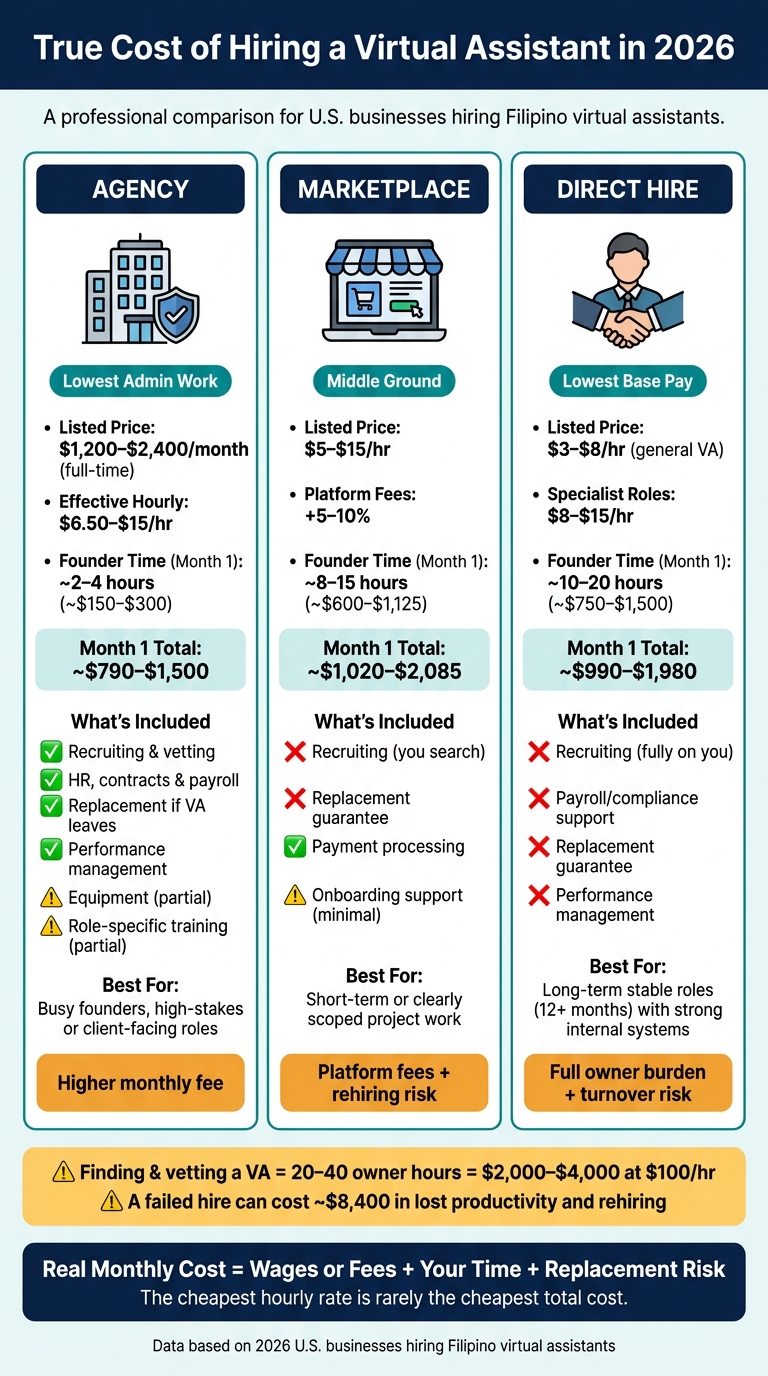
Virtual Assistant Agency vs Marketplace vs Freelancer: True Monthly Cost Comparison 2026
Why Work With A Virtual Assistant Agency vs Freelancers
sbb-itb-3690fed
Quick Comparison
| Model | Typical 2026 Price | What I Handle | Best Fit | Main Cost Risk |
|---|---|---|---|---|
| Agency | $1,200–$2,400/month full-time | Very little | Busy founders, high-stakes roles | Higher monthly fee |
| Marketplace | $5–$15/hour + fees | Search, onboarding, supervision | Short-term or scoped work | Platform fees and rehiring time |
| Direct freelancer | $3–$8/hour for general VA work | Almost everything | Long-term roles with clear systems | My time, turnover, and ramp-up |
If I only compare hourly pay, direct hire wins. If I compare actual spend in dollars and hours, the answer changes fast. That’s what this article shows.
Cost breakdown by hiring model
Posted rate is not the full cost. Recruiting, fees, management, training, and replacement all change what you spend each month. So the better comparison isn't just agency fee versus hourly rate. It's cash cost versus owner time.
Virtual assistant agency: higher monthly fee, less admin work
Agencies cost more at first glance. For Filipino VAs, agency pricing usually lands around $1,200–$2,400/month for a full-time assistant, or about $6.50–$15/hour based on the role and experience level. Specialized bookkeeping or executive support can move toward the top end of that range.
What are you paying for? A lot of the work you don't want on your plate. The agency handles recruiting, testing, payroll, compliance, and replacement. That means a higher monthly bill, but less owner involvement and less risk if the VA leaves.
| Cost Component | Included in Agency Fee? | Notes |
|---|---|---|
| Recruitment & vetting | ✅ Yes | Agency sources and screens candidates before you interview finalists |
| HR, contracts & payroll | ✅ Yes | Contracts, payroll, and local compliance are handled by the agency |
| Equipment & infrastructure | ⚠️ Partial | Some BPO-style setups include office equipment, internet, and monitoring tools; remote-only setups may still need client software licenses |
| Training & onboarding support | ⚠️ Partial | Generic skills training and onboarding help are common; role-specific SOPs usually come from the client |
| Replacement if VA leaves | ✅ Yes | Replacement is usually free or low-cost, with less downtime than starting over |
| Management & performance QA | ✅ Yes | Agency-side supervision reduces the owner's day-to-day management load |
This model tends to work best for buyers who care most about speed, continuity, and keeping management time low. That's the main give-and-take compared with hiring through a marketplace.
Freelance marketplace: lower rates, plus search time and fees
Marketplace rates for Filipino VAs often fall in the $5–$15/hour range, with many operations virtual assistants and customer support roles closer to $5–$10/hour. On paper, that looks cheaper. But platform and transaction fees can add 5–10%, and search plus onboarding can eat up 10–35 hours per hire.
So yes, the posted rate is lower. But it usually comes with less support and no built-in replacement backstop.
| Cost/Factor | Visible Cost | Hidden Time or Risk Cost |
|---|---|---|
| VA hourly rate | $5–$15/hour | - |
| Platform/transaction fees | +5–10% on top of the rate | Raises the effective hourly cost |
| Profile review & interviews | $0 out of pocket | Founder or manager time per hire |
| Onboarding & tool setup | $0 out of pocket | Internal time in the first month |
| Failed hire / rehiring | $0 out of pocket | The full search cycle starts over, with no replacement guarantee |
If the hire doesn't work out, you're back at square one. You restart the search and absorb the downtime. Direct hire can cut cash cost even more, but then every admin task lands on the owner's desk.
Direct hire: lowest base pay, highest owner responsibility
Direct hiring gives you the lowest base pay. Entry-level Filipino VAs often start around $3–$5/hour, developing generalists usually sit around $5–$8/hour, and specialized bookkeeping, marketing support, or executive assistance often lands around $8–$15/hour.
That's the upside.
The downside is that every hidden cost shifts to the owner. You handle sourcing, screening, contracts, payroll setup, onboarding, performance management, and rehiring. Ramp-up can take 20–40 owner hours before output becomes steady.
| Cost Item | Base Pay / Visible Cost | Hidden Burden |
|---|---|---|
| VA base pay | ~$800–$1,500/month for many full-time roles | Still depends on role, skill level, and hours worked |
| Sourcing & interviewing | $0 | Owner handles the full search process |
| Contracts & payroll setup | $0 | International payment setup, transfer fees, and classification issues fall on the business |
| Training & SOP creation | $0 | Early onboarding can take substantial owner or team time |
| Ongoing supervision | $0 | Regular check-ins and performance management are on you |
| Rehiring if VA leaves | $0 | The full cycle repeats, with a productivity gap while you ramp someone else up |
The base rate is the lowest, but the owner takes on the full recruiting load and the downtime risk. In the first few months, the true cost can end up much closer to an agency setup than the base pay suggests. The next section turns these model costs into monthly scenarios for U.S. businesses.
Sample monthly cost scenarios for US businesses
These examples turn the hiring models into month-one costs in U.S. dollars. And once you look at the math that way, the cheapest hourly rate doesn’t always win.
Scenario A: startup hiring one general virtual assistant on a tight budget
Say a founder values their time at $75/hour and needs a general VA for about 20 hours per week, or roughly 80 hours per month.
| Hiring Model | Base Pay (80 hrs) | Fees & Extras | Founder Time Cost (Month 1) | Effective Month 1 Total |
|---|---|---|---|---|
| Agency | $640–$1,200 | Included in fee | ~$150–$300 (2–4 hrs) | ~$790–$1,500 |
| Marketplace | $400–$800 | +5–20% platform fee | ~$600–$1,125 (8–15 hrs) | ~$1,020–$2,085 |
| Direct hire | $240–$480 | Payment transfer and currency conversion | ~$750–$1,500 (10–20 hrs) | ~$990–$1,980 |
In month one, setup time can change the whole picture. Founder time, hiring work, and onboarding often matter more than the posted rate. So a lower advertised price does not always mean a lower total cost up front.
That said, the math shifts fast when the role touches revenue, scheduling, or client response.
Scenario B: busy founder who needs reliable executive support every week
Here, the founder needs 15–25 hours per week of executive support, or about 60–100 hours per month. That usually includes calendar management, inbox triage, meeting prep, and follow-up. In this kind of role, reliability matters more than shaving a few dollars off the rate.
Estimated monthly cash cost: Agency-placed executive assistants usually cost about $600–$2,000 per month at this workload. A marketplace EA often lands around $480–$1,500 per month before platform commission. A direct hire can come in near $360–$1,200 per month.
Risk cost: This is where things get serious. One missed call or one double-booked meeting can hit revenue. If one major scheduling error happens each quarter and costs $5,000, that equals an implied $1,667 per month in expected loss. That alone can wipe out the savings from choosing the lowest-cost option. For a founder whose calendar drives sales, the higher agency fee may end up costing less than the cheaper path with more room for error.
Scenario C: team adding long-term support across functions
Once a company gets to three or more hires, the question changes. It’s less about hourly rate and more about how much work the team must do to keep everything running.
A growing company may need 2–5 VAs spread across admin, customer support, operations, and marketing help. At that point, per-hire overhead stacks up fast.
Estimated monthly cash cost: For three full-time Filipino VAs, direct hire may cost around $1,200–$2,400 per month for general support roles, with higher costs if any role needs specialist skills. A freelance marketplace usually sits between direct hire and agency on listed rates, at roughly $2,400–$5,760 per month before fees depending on role mix and hourly rates. A managed agency model can run about $1,920–$7,200 per month.
Risk cost: With direct hire, every new role brings another sourcing and onboarding cycle. That can mean 20–40 hours of internal time per hire. Across three hires, that turns into a heavy management load before the team is even fully productive. At this stage, repeat hiring cost often matters more than the hourly rate when deciding which model is cheaper.
Which option costs less for each business type
The lowest-cost model depends on the shape of the work: one-off, recurring, or long-term. So the smart move is to match the model to your workload, not just pick the cheapest sticker price.
When an agency delivers the lowest total cost
Agencies make the most sense when a bad hire would cost you time, money, or both. If the role is high-stakes, client-facing, or close to revenue, paying more upfront can save you from a messy miss.
That agency premium usually covers sourcing, vetting, and replacement protection. In plain English, you’re paying for less risk and less admin work on your side. Agencies also typically mark up salaries by 40% to 60% above the assistant's actual wage.
When a marketplace is the lowest-cost workable option
Marketplaces tend to be the cheapest workable choice for short, clearly scoped tasks when you don’t need the same assistant every week. Think one-time CRM cleanup, a research sprint, or transcription.
The catch? You need a tight brief, plus time to screen candidates and manage the hire yourself. If the role turns into steady weekly work, marketplace fees can eat into the savings fast.
When direct hire delivers the lowest total cost
For stable, long-term roles - usually 12 months or more at 20 to 40 hours per week - direct hire of Filipino HR Virtual Assistants or other specialized talent often comes out cheapest overall.
Why? You skip agency markups and recurring platform fees. Direct hire works best when the role is steady and your team can handle management well.
Here’s the simplest way to choose by business type.
| Business type | Best-fit model | Primary reason |
|---|---|---|
| Startup with simple, low-risk tasks | Marketplace for one-off work; direct hire for recurring support | Lowest upfront spend depends on whether the work is project-based or ongoing |
| Busy founder, high-stakes support | Agency | Vetting, speed, and replacement protection reduce costly mistakes and downtime |
| Growing team, ongoing multi-role support | Direct hire | No ongoing markups, so savings add up over 12–24 months |
Final verdict: the lowest posted rate is rarely the lowest real cost
The lowest posted rate often looks like the best deal. But once you factor in time, hand-holding, and the cost of a bad hire, the math can flip fast.
In the examples above, the cheapest listed option did not always lead to the lowest monthly cost. In one case, direct hire came out to $2,370/month, while an agency landed at $2,220/month after hidden costs were added in.
Here’s the rule of thumb:
Real monthly cost = wages or fees + your time + replacement risk.
That’s the part many businesses miss. Posted rates show only one slice of the picture.
In plain terms:
- Agencies reduce admin work and replacement risk the most.
- Marketplaces lower some of that burden, but not all of it.
- Direct hire gives you the most control, but it also keeps the work of hiring, training, and oversight on your side.
And that work adds up. Finding and vetting a VA can take 20–40 hours of owner time, which works out to $2,000–$4,000 at $100/hour. If the hire goes sideways, the hit can be much bigger. A failed hire can cost about $8,400 in lost productivity and rehiring costs.
So which model comes out ahead? It depends on your time, your systems, and how long you plan to keep the VA.
If your time is worth $75/hour or more and you don’t have a formal hiring process, an agency often ends up costing less in practice. You’re paying more up front, sure, but you may save money where it hurts most: delays, rework, and turnover.
If you have the bandwidth to manage people well, plus documented SOPs and solid remote-management systems, direct hire at $6–$10/hour can be the lowest-cost path over a 12–24 month period.
Marketplaces sit in the middle. On paper, they look cheaper than agencies. But platform fees and the time needed to manage the role can eat into that gap pretty fast, especially for long-term hires.
For U.S. businesses hiring Filipino virtual talent in 2026, the deciding number isn’t the lowest posted rate. It’s total monthly cost.
FAQs
How do I calculate total VA hiring cost?
Don’t stop at the base hourly or monthly rate. Start with the role and the person’s experience level, then add a 15%–30% buffer for the extra costs that show up once hiring is in motion.
That usually means things like 13th-month pay, mandatory benefits (14%–22%), software ($50–$150 per month), internet stipends, payroll fees, onboarding time (40–120 hours), and ongoing management time (1–2 hours per month).
When does direct hire become cheaper long term?
Direct hiring tends to cost less over time, especially for teams with fewer than 10 agents. You cut out agency overhead, seat fees, contract minimums, and the 40–80% markup that often gets added on top of base wages.
There is a tradeoff, of course. You have to take care of screening, onboarding, and training yourself. But if your support operation is stable and built for the long haul, that upfront work can pay off with lower monthly costs and more flexibility as you grow.
What hidden costs should I watch for first?
Start with more than the hourly rate. Your total cost often ends up 15% to 30% higher after you factor in required Philippine labor benefits, software, payroll transfer fees, and, in some cases, internet stipends.
You’ll also want to budget for the time spent on recruitment, onboarding, and training, which can add 40 to 120 hours on its own. Then there’s day-to-day management, communication delays, replacement costs if things don’t work out, and the occasional performance bonus. Thinking through these items early can save you from nasty surprises later.