Remote Work
10 Ways To Engage Remote Filipino Teams
Practical steps to hire, communicate, set SOPs/KPIs, protect time, pay fairly, and build culture for engaged remote Filipino teams.
19 min read
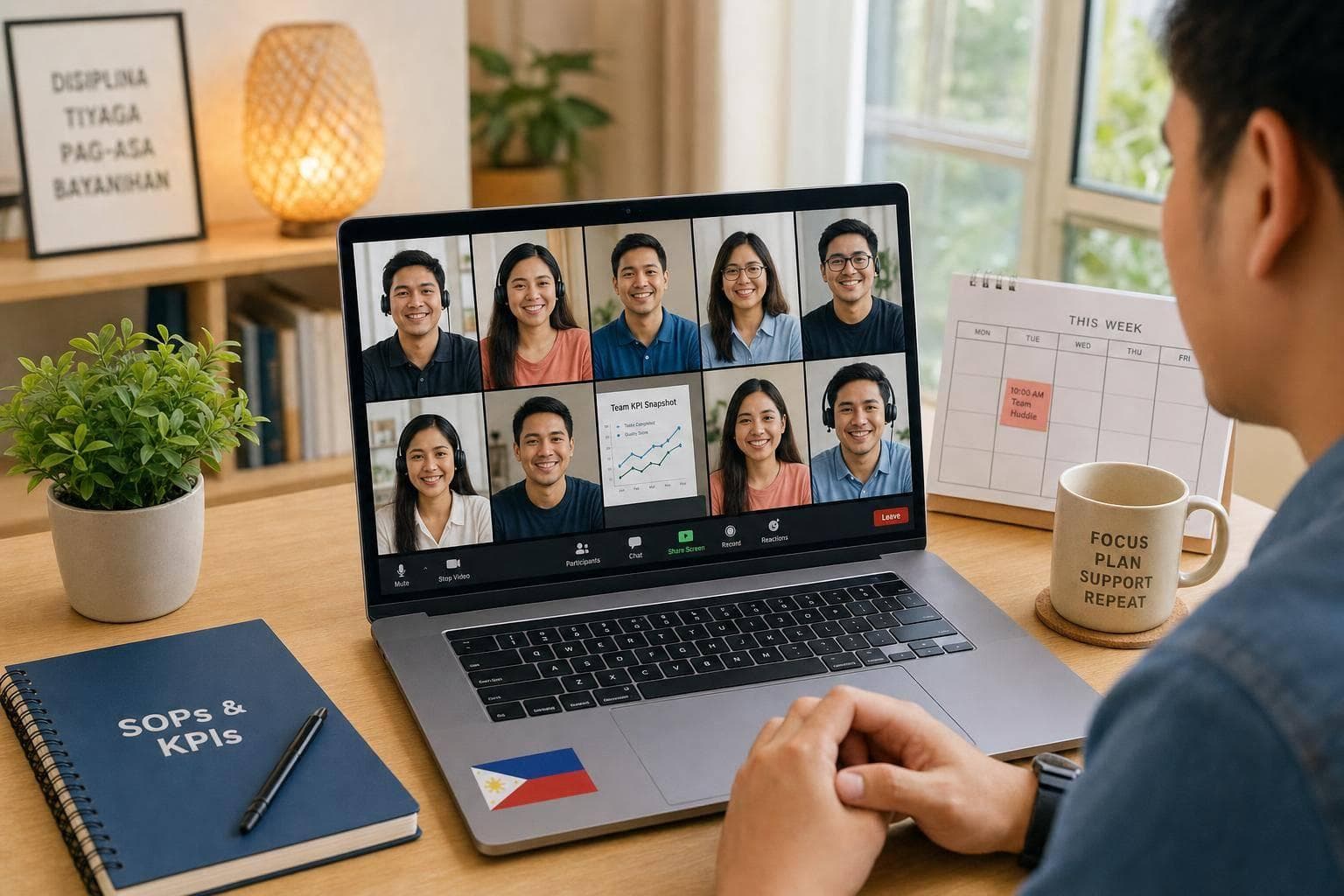
If you want remote Filipino team members to stay engaged, I’d focus on 10 things: hire well, keep communication steady, write clear SOPs and KPIs, give private feedback, protect personal time, show a path for growth, pay well, build team connection, make it safe to speak up, and onboard with structure.
This matters because engaged teams often perform better. The article points to 23% higher profitability, 18% higher productivity, and 43% lower turnover for highly engaged teams. And with a 12- to 16-hour U.S.-Philippines time gap, small mistakes in feedback, scheduling, or expectations can turn into bigger problems fast.
Here’s the short version of what I’d do:
- Hire for fit first, not just skill
- Set weekly 1:1s and use async updates for daily work
- Write down expectations with simple SOPs and 3 to 5 KPIs
- Correct in private and praise in public
- Limit overlap hours and protect nights and weekends
- Make career paths clear with skill steps and monthly growth talks
- Use market-based pay plus useful support like internet and equipment help
- Treat remote staff like part of the team, not extra help
- Ask direct questions so silence doesn’t get mistaken for agreement
- Use a structured first 30 days so new hires can start strong
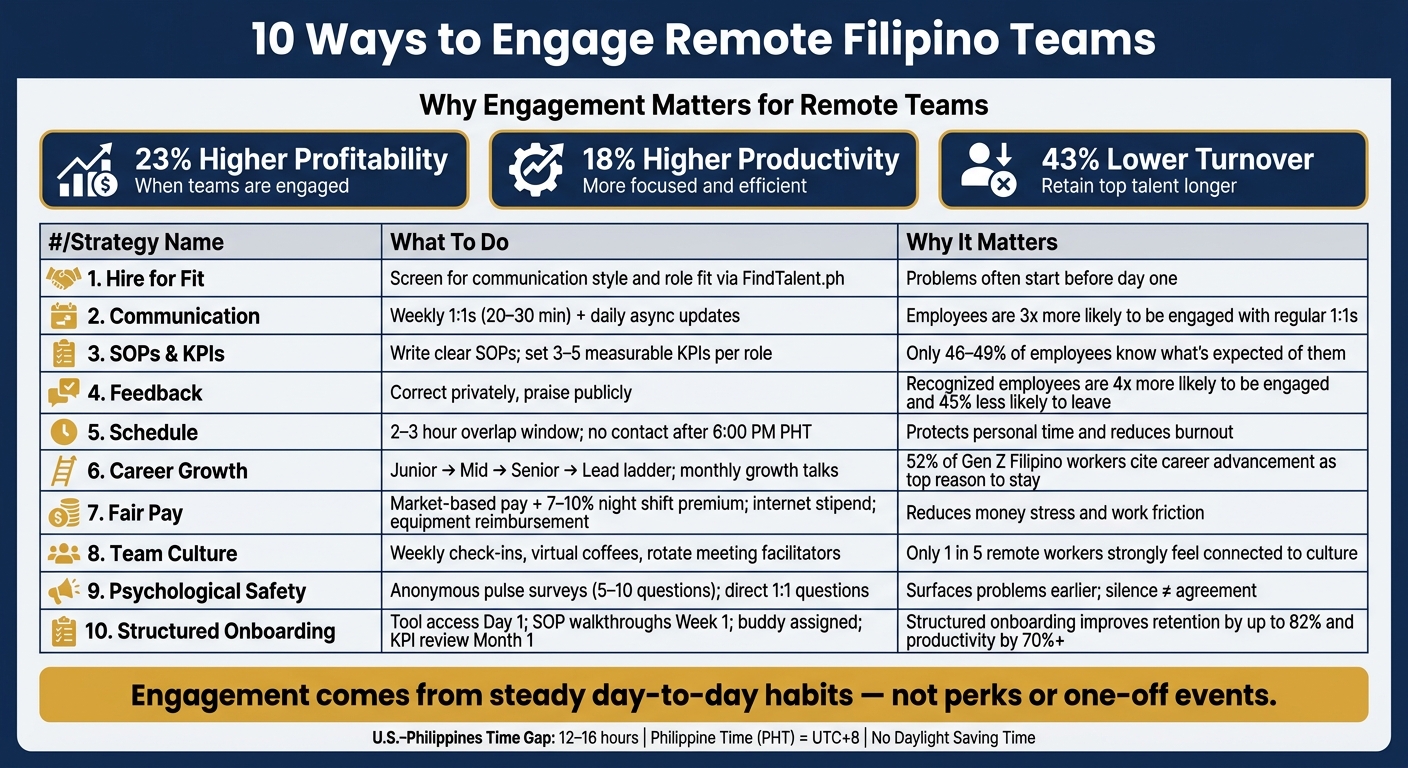
10 Ways to Engage Remote Filipino Teams: Quick Reference Guide
Building Rapport with Your Remote Team in the Philippines
sbb-itb-3690fed
Quick Comparison
| Area | What I’d do | Why it matters |
|---|---|---|
| Hiring | Screen for communication style and role fit | Problems often start before day one |
| Communication | Weekly 1:1s + daily async updates | Keeps work from drifting |
| Expectations | SOPs + clear KPIs | Cuts confusion across time zones |
| Feedback | Private correction, public praise | Helps protect trust |
| Schedule | 2 to 3 overlap hours | Lowers burnout risk |
| Growth | Clear levels and training | Gives people a reason to stay |
| Pay | Competitive pay + practical benefits | Cuts money stress and work friction |
| Team culture | Small team rituals and shared wins | Builds connection |
| Speaking up | Safe 1:1s and short surveys | Problems surface earlier |
| Onboarding | Tool access, SOP walk-throughs, buddy support | Helps new hires get up to speed |
If I had to boil the whole article down to one point, it’s this: engagement comes from steady day-to-day habits, not perks or one-off team events.
Why Engagement Looks Different With Remote Filipino Teams
Remote Filipino teams often respond best to clear direction, visible leadership, and shared goals. That shifts how HR and recruitment specialists and managers need to set expectations, give feedback, and track performance.
Collectivism plays a big part here. Shared goals often matter more than individual wins, so reward systems built only around personal performance can miss what keeps people engaged.
Family orientation also matters. For many Filipino remote workers, stable income and the ability to support parents, siblings, and children sit at the center of why they work hard and stay loyal. That shapes what they expect from an employer, especially around pay, benefits, steady schedules, and empathy when family emergencies come up.
Filipino professionals also tend to soften disagreement. So when someone says "I'll try" or "maybe," that may point to hesitation, not agreement. A simple follow-up question can clear things up fast.
Engagement tends to grow when structure and leadership line up with how Filipino teams work. That’s why the first strategy starts with hiring people who fit remote work from day one. This often involves using a platform to collaborate with top-tier specialists who are already vetted for remote environments.
1. Start With the Right Hire Using FindTalent.ph
Engagement issues often begin before day one.
If someone isn't a good fit for the role, the team, or the manager's way of working, perks and praise won't fix much. That's why hiring the right person is one of the most important ways to keep people engaged. After that, the next part comes down to how clearly you lead.
For Filipino remote hires, communication style matters just as much as technical skill. FindTalent.ph helps you screen candidates for role fit before they start, with more than 3,000 screened specialists across 120+ job titles. That matters because good fit from the start can shape how engaged someone stays.
You can:
- message candidates directly
- ask role-specific questions
- review short intro videos before hiring
The platform also supports specialized hiring across many roles, so you can bring in someone for the exact function you need.
For longer-term engagement, it helps to start with a 30-day trial with clear weekly deliverables. That gives both sides time to see if the working style lines up before turning it into a longer setup. When you hire someone who fits the role and communicates well with your team, it's much easier to build good habits around feedback, expectations, and day-to-day work.
2. Set a Consistent Communication Schedule
Once you’ve made the right hire, the next job is simple: don’t let the working relationship drift.
A steady communication rhythm helps keep things on track. Without it, remote Filipino employees may not know when feedback is coming, when decisions will be made, or when they should bring up concerns. That kind of uncertainty can chip away at engagement. Gallup research shows that employees are about three times more likely to be engaged when their managers hold regular one-on-one meetings with them.
The U.S.–Philippines time gap is usually 12–15 hours, depending on your time zone. When it’s 9:00 AM Eastern Time, it’s already 9:00–10:00 PM in Manila. So spontaneous check-ins usually don’t work. You need a set rhythm that both sides can plan around.
A good starting point is:
- a weekly 1:1 for 20–30 minutes
- a short daily async status update
Use live calls for alignment and feedback. Put routine updates in Slack or a project board.
This matters even more with Filipino teams, where direct interruption can feel uncomfortable. Filipino work culture puts real weight on pakikisama - keeping harmony - and hiya, a strong reluctance to feel embarrassed. In plain terms, team members may be less likely to ask for an unscheduled call when something feels unclear.
Predictable check-ins create a safe, expected space to ask questions without feeling like they’re crossing a line. During those sessions, be direct. State priorities in plain English. State deadlines in U.S. format, like “by 09/30 at 5:00 PM PT.” And ask for questions outright.
"What's unclear right now?"
That small prompt can go a long way.
3. Write Down Expectations With SOPs and KPIs
Once communication feels steady, put the work in writing so it doesn't live in someone's head or depend on constant check-ins. For remote Filipino teams, written SOPs and KPIs make day-to-day work much clearer across time zones. They cut confusion, help people make decisions faster, and give remote employees more confidence to act on their own. Without written standards, alignment can drift. With them, people can move without waiting for live input.
Gallup says clarity of expectations is the most basic part of employee engagement, yet only about 46%–49% of employees strongly agree they know what's expected of them at work. For remote teams spread across time zones, written expectations help stop delays and misunderstandings before they start.
SOPs work best when they're tied to the role and easy to scan. A virtual assistant helping a U.S.-based real estate agent might need calendar rules in the client's time zone, plus clear steps for what counts as urgent and when to escalate. A customer support rep might need refund decision trees and a defined path for handling more complex complaints. And instead of dumping everything into long paragraphs, use screenshots and short screen recordings.
Once SOPs spell out how the work should happen, KPIs show what good performance looks like. Keep it simple: 3–5 measurable metrics per role is usually enough. That could mean task completion rate, first-contact resolution, or on-time delivery of milestones. Employees who know the standards for top performance are nearly four times more likely to be engaged.
Build KPIs with the employee, not for the employee. That small shift matters. When people help shape the metrics, they're more likely to take ownership and speak up early when something is off.
4. Give Feedback Privately and Recognition Publicly
In Filipino teams, public criticism can spark hiya and chip away at trust.
Correct privately. Recognize publicly. If there’s a problem, handle it in a private call or direct message. Stay calm. Talk about the behavior, not the person. That kind of private coaching protects dignity while still making expectations clear.
Public praise matters too, but it works best when it’s specific and linked to actual results. For example:
- solving a client issue
- improving quality
- hitting a team target
Use team calls and group chats to highlight wins that connect to those outcomes.
The numbers back this up. Employees who feel recognized are 4x more likely to be engaged and 45% less likely to leave their organization. Gallup also found that employees who get both feedback and recognition at least once a week are 61% engaged, compared with 38% for those who get feedback alone.
A steady weekly rhythm helps. When feedback and recognition happen on a set cadence, they feel normal and useful - not random, delayed, or rushed.
5. Respect Time Zones and Protect Personal Time
Once expectations and feedback cycles are in place, the next signal people notice is simple: do you respect their time? Philippine Standard Time is UTC+8, and U.S. and Philippine work hours usually don’t line up on their own. If off-hours work becomes the norm, burnout and turnover tend to follow.
A better setup is a 2–3 hour overlap window for live calls instead of trying to force full-day overlap. Keep status updates, assignments, and approvals in async tools, and use recorded video updates when live meetings aren’t needed. That approach helps teams move fast without eating into personal time.
For many Filipino teams, family time matters a lot. Respecting personal time shows trust, and that often builds loyalty.
The key is to make that respect part of policy, not something managers handle on the fly. Put time boundaries into the schedule. Define working hours in PHT for each role. Set a clear no-contact window after 6:00 p.m. PHT, except for pre-defined emergencies. Protect at least one full weekend day. Managers should also set the tone by scheduling messages to arrive during PHT business hours. If exceptions come up, flag the timeline early, rotate on-call coverage, and compensate people fairly with overtime pay or time off in lieu.
Because the Philippines does not use daylight saving time, the U.S.–PHT gap shifts by one hour when U.S. clocks change. A shared calendar that shows both time zones can help teams avoid accidental off-hours scheduling.
6. Offer Clear Career Growth and Learning Opportunities
Once you've protected personal time, the next thing people look for is a future they can actually see. A Jobstreet survey found that 52% of Gen Z workers in the Philippines say career advancement is their main reason for staying with an employer. That puts growth ahead of pay alone.
Filipino professionals also have a strong drive to learn. 40% are willing to spend time each week building new skills, and 77% are open to retraining for a different role. When people already want to learn, training programs tend to work much better.
Give that growth a clear shape. A simple ladder like Junior, Mid, Senior, Lead helps people see where they are and what comes next. Spell out the criteria at each level, including skills, certifications, and behaviors. If you can, offer two paths:
- A management track for people who want to lead teams
- A specialist track for people who want to go deeper in technical work
That sends a plain message: advancement is real, and people earn it through their work.
Career talks also shouldn't be saved for annual reviews. Bring growth into monthly one-on-ones and quarterly check-ins. Use those meetings to look at goals, skill gaps, and development plans. For remote workers, silence from a manager can feel like a dead end. Regular talks replace that silence with clarity. Then match those talks with training tied to the next role.
Use short async courses, role-based training, tool tutorials, and stretch assignments that connect to the next step. For example, ask a mid-level support specialist to document an SOP, or give a senior VA a stretch project. Moves like that build skill without throwing off day-to-day output. The goal is simple: make learning part of the job, not something people have to squeeze in after hours.
7. Pay Fairly and Offer Practical Benefits
After growth, pay is the next big lever for retention. Fair pay shows respect, lowers money stress, and helps remote Filipino employees stay engaged. That matters even more because many Filipino workers help support extended family, so steady, competitive pay often goes toward education, healthcare, and day-to-day bills.
Start by checking pay against Philippine market rates. Then set offers around the mid-to-upper end based on the role, skill level, and work schedule. Use Philippine benchmarks to price roles fairly, and make sure you account for night work too. Total compensation should reflect more than just the job title. It should also cover skill level, niche expertise, and shift timing. If someone works U.S. hours or regularly handles night shifts, a 7%–10% premium or more is common.
It also helps to back base pay with a simple bonus plan. A monthly bonus tied to clear KPIs can work well, especially when the formula, payout timing, and triggers are explained upfront. People tend to stay longer when they know exactly how the system works.
Practical benefits matter just as much. In remote roles, the most common problems are often basic ones: unstable internet, weak equipment, or medical costs that pull attention away from work. That’s why companies should put these supports near the top of the list:
- Internet stipends
- Equipment reimbursement
- Health coverage or a health allowance
These are common tools used to keep remote teams steady and reduce day-to-day friction.
If you hire workers as employees, local payroll rules come into play too. Under Philippine labor law, employers may need to budget for 13th-month pay. Many foreign employers also add a year-end bonus to stay competitive in the market.
8. Build a Team Culture That Includes Remote Members
Pay and benefits help stop people from leaving. Culture is what makes them want to stay.
Once compensation is in a good place, culture often becomes the bigger reason people stick around. For Filipino remote employees, that difference matters. Filipino workplace culture is collectivist, shaped by values like bayanihan (shared effort), pakikisama (harmony), and hiya (fear of embarrassment). Those values shape whether people feel they belong and whether they see themselves as part of the team instead of outside contributors.
Flexibility by itself doesn't create connection. You have to build that connection on purpose.
Instead of relying on the occasional team-building event, use steady, low-pressure rituals. A weekly check-in that starts with "How are you doing?" shows that managers care about the person, not just the output. Small habits can go a long way:
- A weekly check-in
- A short virtual coffee
- Brief team wins tied to group effort
Belonging also depends on whether remote employees have a real voice in meetings. Rotate facilitators, use polls or chat, and send written summaries after the meeting so quieter team members can contribute without extra pressure. When people see their input show up in decisions, they feel like members of the team, not contractors.
One common mistake is treating remote Filipino staff as transactional labor instead of core team members. That framing clashes directly with collectivist expectations of mutual loyalty and respect. The fix is pretty simple: involve remote Filipino employees in team initiatives, celebrate milestones together, and make it clear through steady behavior that they belong.
Gallup found that only about 1 in 5 remote, hybrid, and on-site workers strongly feel connected to culture, which shows leadership matters more than location. That kind of inclusion makes it easier for people to speak up when something is wrong.
9. Make It Safe for Employees To Speak Up
Remote engagement gets better when Filipino employees can bring up problems early without worrying about fallout. This matters just as much as clear goals and steady communication.
In many Filipino teams, people may communicate indirectly. They may also avoid speaking up because they don't want to feel embarrassed. So silence doesn't always mean agreement. Sometimes it just means hesitation.
The goal is simple: make speaking up a normal part of work. Make it private when needed. And make it safe by default.
That starts with manager behavior. Sensitive feedback should happen in private, because public criticism can make people shut down. In 1:1s, ask direct questions like: "What is making your work harder right now?" In team meetings, rotate speaking turns and keep one agenda slot open for process concerns.
Anonymous pulse surveys can help too. Keep them short, around five to 10 questions, and send them during Philippine business hours. Then share the results with the team and explain what will change. If people take time to answer and nothing happens after, trust drops fast.
A few signals can tell you something is off:
- Questions go unanswered
- Problems get escalated late
- QA meetings start to feel tense or guarded
When managers respond with curiosity instead of blame, people are more likely to speak honestly. And when leaders act on what they hear, that habit starts to stick. Once that openness is in place, onboarding specialists should reinforce it from day one.
10. Build a Strong Onboarding Process for Remote Filipino Hires
The first week sets the tone. Onboarding is where your communication style, SOPs, and feedback habits stop being ideas on paper and start becoming part of daily work. If the start feels messy, it tells a new hire your remote setup is messy too.
The data is hard to ignore. Organizations with structured onboarding improve new-hire retention by up to 82% and productivity by more than 70%. That matters even more when your team works across time zones.
Your onboarding should mirror the same clarity, pace, and tone you expect after hiring. In plain English: new hires should get tool access, key SOP walkthroughs, and clear first-week priorities before they have to chase anyone down for help. That’s the point where remote hires either build momentum or get stuck.
A simple setup works best:
- Day 1: Set up email, Slack, and the task manager
- Early in week one: Walk through one or two key SOPs
- Later: Hold off on secondary tools until they’re actually needed
Then there’s the human side. Process matters, but people also need a sense of connection. Assign a buddy or mentor for the first 30 to 90 days so new hires have someone to ask about the unwritten rules, not just the documented ones. Start with a team welcome call, not only a one-on-one with the manager. Filipino work culture values pakikisama, so a purely transactional start can feel cold even if the setup is technically correct.
Clear onboarding helps new hires take ownership sooner, cuts confusion, and lowers early turnover.
Comparison Tables
Use these tables as a quick reference when you put the ideas above into action. They help turn communication, recognition, incentives, and onboarding into day-to-day habits instead of one-off fixes.
Synchronous vs. Asynchronous Communication
The Philippines is usually 12 hours ahead of ET and 15 hours ahead of PT. Because of that time gap, choosing the right communication style isn't a small detail. It's one of the most practical calls you'll make.
The goal is simple: match the meeting style to the work, not the other way around.
| Synchronous | Asynchronous | |
|---|---|---|
| Best for | Decisions, coaching, urgent issues, standups | Status updates, documentation, focused work, handoffs |
| Tools | Zoom, Google Meet, Slack (live) | Loom, Notion, Asana, Slack (threaded) |
| Response time | Immediate | 12–24 hours |
| Risk | Burnout if overused across time zones | Misalignment without clear SOPs |
| Recommended use | 2–4 hour overlap window daily | Default for everything else |
Scheduling Models
This table shows how common schedule setups line up across U.S. and Philippines time zones.
| Model | U.S. Time (ET) | Philippines Time (PHT) | Best for |
|---|---|---|---|
| U.S. Business Hours | 9:00 AM – 5:00 PM | 9:00 PM – 5:00 AM | Customer support, sales, live coverage |
| Split Shift | 8:00 AM – 12:00 PM | 8:00 PM – 12:00 AM | Partial overlap with morning PHT tasks |
| Async / PHT Day | As needed | 9:00 AM – 6:00 PM | Content, admin, dev, back-office work |
Full U.S. hours come with the highest burnout risk. In many cases, the split shift or async-first model is the better fit because it protects local rest time while still giving U.S. teams a dependable overlap window.
Individual vs. Team-Based Recognition
Use private recognition for individual wins and public recognition for shared results. That's usually the cleanest way to make praise feel fair and well-placed.
| Individual Recognition | Team-Based Recognition | |
|---|---|---|
| Best for | Specific achievements, skill growth, accountability | Collective wins, project completion, collaboration |
| Format | Private message, public channel shout-out, spot award | All-hands mention, shared bonus, team channel post |
| Cultural note | Private appreciation works well for personal milestones or sensitive feedback | Public praise in team channels works well for shared wins and belonging |
A blended approach tends to work well: recognize individuals for standout contributions, and recognize the full team for shared delivery goals.
Incentive Types
Not every incentive has to be a bonus. Some remove friction. Others help people grow over time.
| Incentive | Type | Frequency | Best for |
|---|---|---|---|
| Performance bonus | Cash | Monthly or quarterly | Hitting KPIs, sales targets, customer satisfaction goals |
| Internet/equipment stipend | Practical | Monthly or one-time | Reducing remote work friction |
| Learning budget | Non-cash | Ongoing | Long-term retention and skill growth |
Feedback Channels
A good feedback system gives people more than one way to speak up. Some issues belong in private. Others are easier to spot through patterns.
| Channel | Privacy | Best for | Ideal frequency |
|---|---|---|---|
| Anonymous pulse survey | High | Surfacing trends, sensitive issues | Quarterly |
| 1:1 video call | Private | Coaching, blockers, relationship-building | Weekly or biweekly |
| Async weekly update | Transparent | Manager visibility without extra meetings | Weekly |
Onboarding Milestones
Use this table to track what should happen at each stage of a remote hire's first 30 days. It keeps early expectations clear and helps new team members get up to speed without guesswork.
| Phase | Owner | Key Activities |
|---|---|---|
| Day 1 | HR + Manager | Tool access and login credentials (Slack, task manager, email), role expectations, team intro call, first-day checklist |
| Week 1 | Manager | SOP walkthroughs, workflows, communication norms, first small task, buddy or mentor assigned |
| Month 1 | Employee + Manager | Full task ownership, limited supervision, formal check-in, performance vs. KPIs review |
Notes for U.S.-Based Employers
Use these notes to read costs, dates, and schedules in U.S. terms.
Stick with USD throughout. A full-time Filipino virtual assistant usually costs $800–$1,500 per month, while a senior web developer usually falls between $1,400–$3,500 per month. Direct-hire rates can be 60%–80% lower than similar U.S. roles.
Use Month Day, Year for dates and 12-hour AM/PM for time. Philippine Time (PHT, UTC+8) does not use daylight saving time. That means the time gap between the U.S. and the Philippines changes when U.S. clocks move forward or back.
For scheduling, factor in local holidays. It’s a simple step, but it can save a lot of friction. This matters even more if your team works PHT daytime hours. Key dates include:
- New Year's Day (January 1)
- Araw ng Kagitingan (April 9)
- Labor Day (May 1)
- Independence Day (June 12)
- Bonifacio Day (November 30)
- Christmas Day (December 25)
- Rizal Day (December 30)
Holy Week matters too, especially Maundy Thursday and Good Friday. If you schedule a big launch or a required all-hands meeting on those dates, attendance and engagement can take a hit.
Set clear written expectations. Also give people an anonymous way to flag concerns, which can help issues surface sooner. FindTalent.ph can help U.S. employers hire verified Filipino specialists in customer support, bookkeeping, content creation, and web development , or even Filipino talent sourcers while staying within USD budgets and U.S. hiring norms.
Conclusion
Engagement comes from steady habits, not one-time pushes.
Three levers shape retention: connection, growth, and consistency.
The fastest way to find weak spots is with a regular engagement audit. Run that audit every quarter or twice a year with a short anonymous survey that covers communication, pay, recognition, growth, and respect. Then compare those results with retention and performance data, and assign two or three fixes with clear owners and deadlines.
The aim isn’t to build a perfect system on day one. It’s to build one that gets a little better each time you review it.
FAQs
How do I know if a Filipino remote hire is a good fit?
Skip the resume-only approach. Use a structured evaluation process instead.
Start with a 30-day trial and set clear weekly deliverables, so you can see how the person works week by week, not just how they interview.
For technical roles or jobs with lots of process, add a paid 2–4 hour trial task. Have them use your tools and workflows. That gives you a much better read on practical judgment and how well they follow procedures.
It also helps to check a few day-to-day fit points:
- Proactive communication
- Comfort with your software stack
- Time-zone flexibility
- An English communication style that fits your team
FindTalent.ph can help you compare verified profiles side by side.
What is the best schedule for U.S. and Philippine teams?
The best schedule comes down to how your team works together day to day. That said, many U.S. companies aim for a 4- to 5-hour overlap with their business hours. It gives teams enough shared time for meetings, status checks, and smoother handoffs without forcing everyone to be online at the exact same time.
One common setup is 12:00 PM to 9:00 PM PHT. That schedule lines up well with U.S. mornings, especially for Pacific Time teams. It also helps when you need live back-and-forth instead of long delays between messages.
Filipino specialists are often used to flexible shifts, including overnight hours, so this kind of arrangement is pretty common.
How can I improve engagement without causing burnout?
Set clear expectations and build smooth workflows to cut down on avoidable friction. Use detailed standard operating procedures and asynchronous communication so people can work without constant interruptions.
Lean on structured written updates for completed tasks, blockers, and next steps instead of packing the calendar with live meetings. Offer clear, well-defined pay, and use FindTalent.ph to hire pre-vetted Filipino specialists who are a strong fit from day one.