Business Operations
Why Outsource Lead Generation to the Philippines?
Cut lead costs and boost meetings by hiring Filipino lead-gen specialists for research, outreach, CRM, and appointment setting.
10 min read
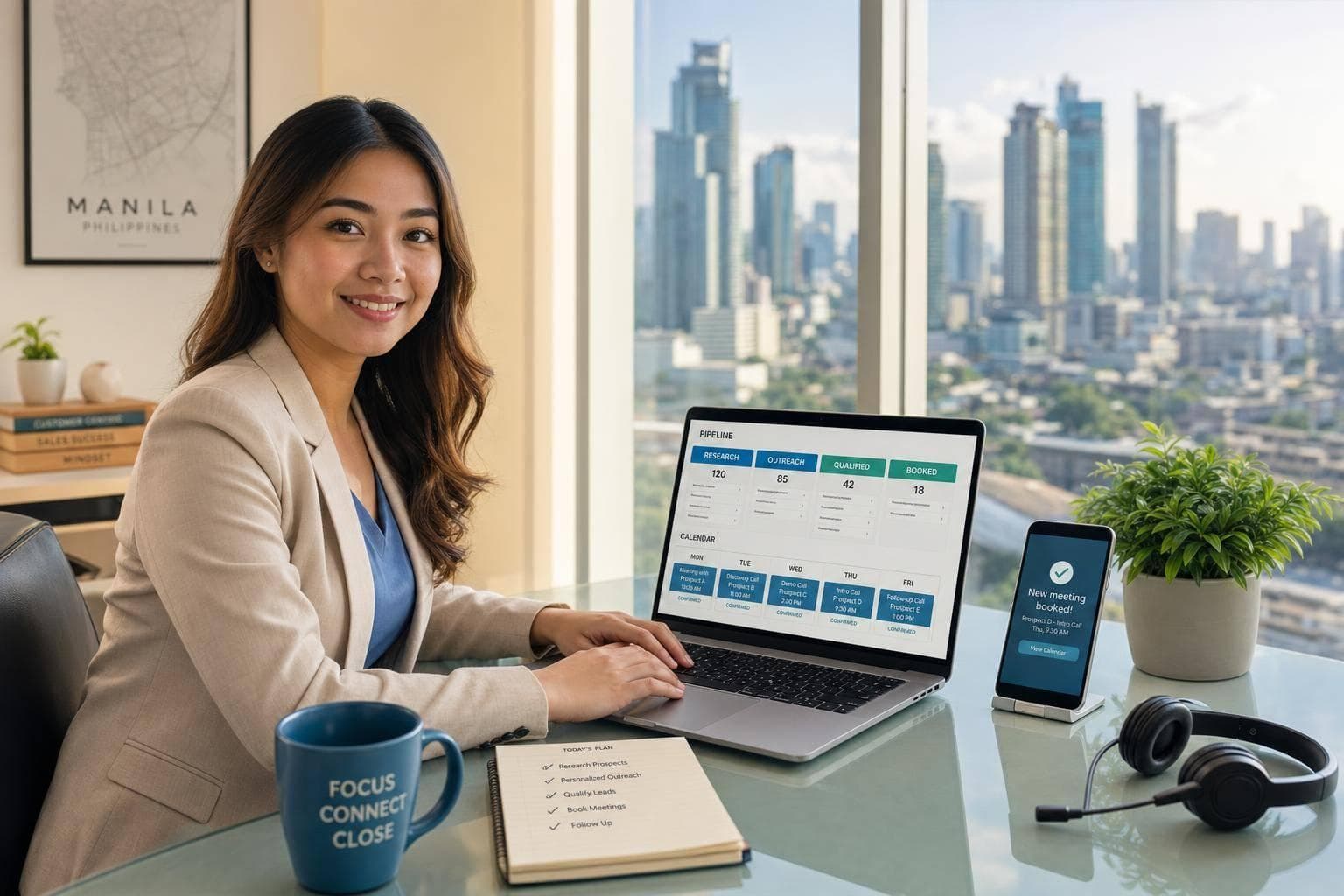
If your team is not booking enough sales calls, outsourcing lead generation to the Philippines can lower labor costs, keep follow-up on time, and give your U.S. reps more selling time.
I’d sum it up like this: many U.S. businesses miss revenue targets not because the offer is weak, but because lead research, outreach, list cleaning, and follow-up are inconsistent. Hiring Filipino lead gen support helps cover that gap with lower monthly costs, strong English skills, night-shift coverage for U.S. hours, and workers who already know SDR, appointment setting, and CRM work.
Here’s the article in plain English:
- The core problem: pipeline stalls when founders and reps try to prospect between other tasks.
- What goes wrong in-house: low outreach volume, bad contact data, and slow follow-up.
- Why the Philippines fits: strong English use, large BPO sales workforce, and time zone coverage for U.S. teams.
- What the numbers show: Filipino lead gen staff often cost around $800 to $1,400 per month, while a U.S. SDR can run $8,000 to $12,000 per month fully loaded.
- Where the work helps most: list building, data cleanup, cold email, cold calling, qualification, CRM updates, and appointment setting.
- What teams may gain: lower cost per lead, more daily outreach, and more meetings booked.
- How to hire: platforms like FindTalent.ph can help match businesses with verified Filipino workers for roles like SDR, cold caller, researcher, VA, and CRM support.
One stat stands out: if 30% to 50% of your list is wrong, outreach breaks before it starts. And if follow-up slips, even warm leads go cold. That’s why this article points to the Philippines as a simple staffing option for sales teams that need more pipeline without adding full U.S.-level payroll.
If I were reading this to make a hiring call, that would be the short answer.
Why the Philippines Works Well for Lead Generation
English Skills and Communication That Work with U.S. Teams
Lead generation breaks down fast when outreach feels uneven, records get sloppy, and follow-up drags. The Philippines helps on all three fronts.
The Philippines ranks in the High Proficiency tier on the EF English Proficiency Index and is among the top English-speaking countries in Asia. English is used across the school system and in many workplaces, which gives Filipino professionals a strong base for day-to-day sales work. That shows up in cold emails written in natural U.S. business English, qualification calls that sound clear and smooth, and CRM notes that are clean and usable.
There’s also a practical edge here. Decades of serving U.S. clients have shaped communication training around American tone, reply expectations, and objection handling. So this isn’t just about speaking English. It’s about communicating in a way that fits how U.S. teams sell.
That carries straight into calling, lead qualification, and CRM handoff.
A Workforce Experienced in SDR, Appointment Setting, and Follow-Up Roles
The Philippines is a major voice BPO hub. That matters because lead generation work often lives or dies on repetition, process, and consistency.
The country has a large pool of outbound-trained contact center talent, and many workers already know the basics that U.S. sales teams care about: qualification frameworks, script adherence, CRM discipline, and performance-driven sales settings. In plain terms, you’re not starting from zero.
Filipino SDRs and appointment setters are also used to common sales and CRM tools. Many already track the KPIs that matter, including:
- dials per day
- booked meetings
- show rates
That can shorten ramp time when a U.S. company brings them on.
That same background also helps with after-hours support.
Time Zone Coverage That Extends Your Sales Hours
The Philippines operates on UTC+8, roughly 12 to 15 hours ahead of U.S. time zones depending on the region and daylight saving time. For lead generation, that time gap can work in your favor. While your U.S. team is offline, the pipeline can keep moving.
Filipino professionals are used to night-shift schedules that match U.S. business hours. They can qualify inbound leads, run outbound sequences, and update the CRM so your team starts the day with fresh notes and a queue of booked meetings. It’s a bit like waking up to a desk that’s already been cleared.
For East Coast companies, there is typically a 3–5 hour direct overlap for standups and live collaboration, with async handoffs covering the rest. West Coast teams can get a full 8-hour overlap if Filipino staff work nights.
sbb-itb-3690fed
Cost and Efficiency Gains From Outsourcing Lead Generation
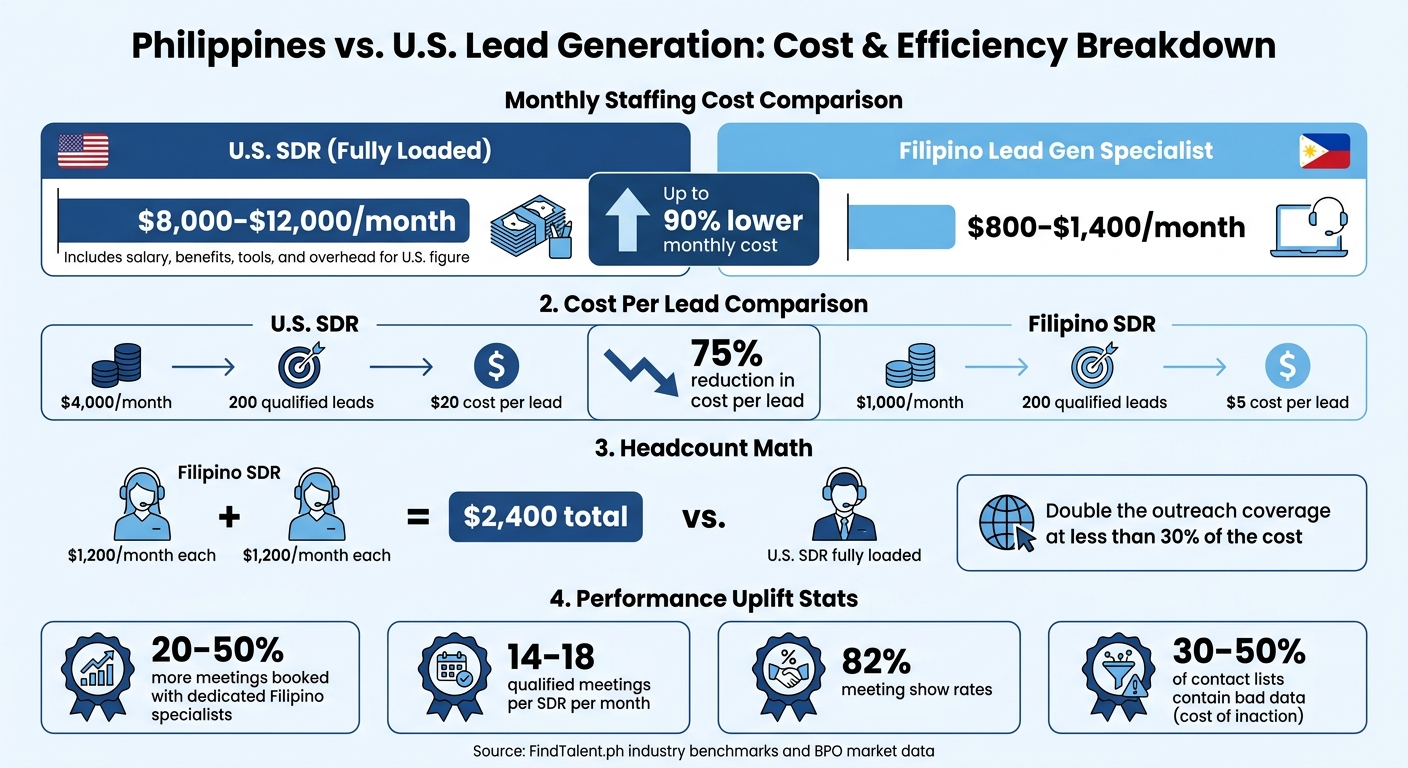
Philippines vs. U.S. Lead Generation Costs: The Full Breakdown
Lower Staffing Costs Without Losing Dedicated Coverage
A full-time Filipino lead generation specialist typically costs $800–$1,400 per month, or about $8–$13 per hour, depending on the role and level of experience. A similar U.S. SDR can cost $8,000–$12,000 per month fully loaded, once you include salary, benefits, tools, and overhead.
For SMBs, that gap changes the math fast. At $1,200 each, two Filipino SDRs can cost less than one fully loaded U.S. hire. That means more outbound coverage without pushing payroll up at the same pace. It also gives teams more room to deal with seasonal swings or uneven pipeline volume. You still get full-time prospecting support, just without the heavy fixed salary.
The cost-per-lead picture changes too. If a domestic SDR at $4,000 per month produces 200 qualified leads, your labor cost per lead is $20. If a Filipino SDR at $1,000 per month delivers that same output, the cost drops to $5 per lead. That's a 75% reduction.
Faster Execution Through Dedicated, Specialized Support
Lower cost matters. But day-to-day consistency is what keeps lead gen from stalling out.
When founders or AEs try to do prospecting on top of everything else, it usually gets bumped down the list. Follow-up slows down. Outreach becomes uneven. Leads sit too long. Dedicated Filipino specialists help fix that by dividing the work into clear roles.
A Lead Research & Data Specialist handles list building, data cleanup, and enrichment. An Outbound SDR / Appointment Setter manages daily email sequences and calls. A CRM Specialist keeps records clean and opportunity stages up to date.
That kind of role split makes a big difference. Each person owns one part of the process, so work doesn't get lost just because someone had to jump on a sales call or close a deal.
The payoff is simple: more steady daily output, faster speed to first contact, and fewer leads going cold. U.S. teams that make this shift often see 20–50% more meetings booked.
Comparison Table: In-House Challenges vs. Philippine Outsourcing Solutions
Here's what that looks like side by side.
| In-House Challenge | How Philippine Outsourcing Addresses It | Expected Business Impact |
|---|---|---|
| High staffing cost constraining headcount | Specialists at $800–$1,400 per month vs. $8,000–$12,000 per month fully loaded | More outreach capacity for the same or lower budget |
| No dedicated ownership of prospecting tasks | Defined roles split research, outreach, and CRM across specialists | Consistent daily output; fewer leads falling through the cracks |
| Inconsistent CRM data harming reporting | CRM specialists keep records clean and current | Cleaner pipeline data; better forecasting and segmentation |
How Filipino Professionals Address Core Lead Generation Problems
Research, List Building, and Data Cleanup for Better Targeting
This is where outsourcing becomes day-to-day execution: cleaner lists, more consistent outreach, and more booked meetings. If the data is bad, the campaign is in trouble from the start.
Filipino lead research specialists help fix that. They build and verify ICP-based lists using firmographic filters like industry, company size, geography, job title, and intent signals. Then they check each contact before it enters the outreach queue, including the domain, current role, and current employer.
Cold Outreach, Qualification, and Appointment Setting at Scale
Filipino SDRs and appointment setters keep outreach moving with daily email, phone, and LinkedIn cadences. In most setups, the workflow blends email, calls, and LinkedIn touches, with every step logged in the CRM.
Outreach stays personal because teams use verified lead data in their templates instead of sending generic messages. When a lead shows interest, replies go straight to U.S. reps’ calendars. Teams report 14–18 qualified meetings per SDR per month, 82% show rates, and solid pipeline lift.
Task-to-Role Table: Who Handles What and Which Metrics Improve
The table below shows how each task lines up with a role and the sales metric it helps move.
| Lead Generation Task | Typical Filipino Role | Key Metrics Improved |
|---|---|---|
| Prospect research & list building | Lead Researcher | Lead quality, bounce rate |
| CRM updates & data cleanup | Operations VA | Data integrity, pipeline visibility |
| Cold email outreach | SDR | Open rate, reply rate |
| Cold calling | Cold Caller | Connection rate, qualification speed |
| LinkedIn outreach | Lead Gen Specialist | Acceptance rate, response rate |
| Follow-up sequences | SDR | Lead-to-meeting rate, response time |
| Appointment setting | Appointment Setter | Meetings booked, show rate |
Using FindTalent.ph to Hire Verified Filipino Lead Generation Talent
How FindTalent.ph Helps Businesses Hire Faster With Less Guesswork
When lead gen slows down, the fastest fix is often simple: hire for the exact job that's causing the bottleneck.
Once you've pinned down the role you need, the next step is finding someone fast who can step in and do the work. FindTalent.ph is built for that. It connects U.S. businesses with Filipino specialists who can help fix gaps in outreach volume, data quality, and follow-up.
The platform has 3,000+ screened Filipino specialists across 120+ roles. Before a specialist appears on the platform, they go through KYC identity verification and a profile review. That means you don't have to dig through unverified applicants and hope for the best.
Its AI-powered search also makes hiring simpler. You can describe what you need in plain English, and the platform returns ranked matches in minutes. If you want a more hands-off route, the Recruiter-Assisted option adds a $600 flat fee. With that service, the FindTalent.ph team sources, screens, and sends 1–3 pre-vetted candidates straight to your inbox. It also comes with a free replacement guarantee if the match doesn't work out.
Matching Lead Generation Gaps to the Right Talent Category on FindTalent.ph
The easiest way to speed up hiring is to match the problem to the right type of hire. Here's how common lead generation issues line up with FindTalent.ph talent categories and what each role can help improve.
| Lead Generation Challenge | Relevant Talent Category | Result |
|---|---|---|
| Low volume of outbound calls | Cold Caller | Increased daily outreach and prospect contact rates |
| Poor data quality/outdated lists | Data & Analytics (Market Research Analyst) | Cleaner lead lists and better targeting accuracy |
| Sales team overwhelmed by admin | Admin & Virtual Assistants (General VA or Executive Assistant) | Sales closers focus only on high-value meetings |
| Slow follow-up on inbound leads | Sales & Lead Generation (Virtual Assistant or Sales Assistant) | Faster response times and improved lead-to-appointment ratios |
| Manual workflows | AI & Automation (Zapier Expert or AI Specialist) | Automated lead routing and reduced manual data entry |
Conclusion: Why the Philippines Is a Practical Lead Generation Solution
FindTalent.ph makes it easier to hire verified Filipino lead generation talent without a long, messy hiring cycle. Between AI-powered matching, verified profiles, and a recruiter-assisted option, the platform gives lean U.S. sales teams a direct way to fix issues with volume, data quality, and follow-up speed.
FAQs
What tasks should I outsource first?
Start with routine, process-based tasks that eat up time but don’t need much high-level judgment, such as:
- inbox management
- scheduling
- data entry
- basic administrative work
Handing these tasks off to Filipino professionals gives you more time for higher-impact work that needs your attention. Once things are running smoothly, you can branch out into roles like social media management, lead generation, or customer support.
How do I manage a Filipino lead gen team?
Manage a Filipino lead generation team with clear processes and steady communication. Write down your SOPs, use a shared QA rubric, and check KPIs every week so the work stays consistent from one agent to the next.
For teams with 3 to 5 agents, assign a team lead to handle escalations and keep standards in place. Use async tools for day-to-day updates, set a few overlap hours for stand-ups, and make space for open feedback so unclear requirements come up early instead of turning into bigger issues later.
What results should I expect in the first 90 days?
In the first 90 days, you should see a clear shift from onboarding to steady, productive work. It usually starts with a 30-day trial period, which gives you time to confirm that the working relationship is a good fit.
During that window, set clear standard operating procedures and define weekly deliverables so performance is easy to track. By the end of the 90 days, you should have a reliable professional who fits into your workflows and understands your business needs.