Remote Work
How to Hire Developers in the Philippines (2026): Rates, Vetting, and Red Flags
Budget realistic rates, run a structured vetting process, and use a paid trial to hire reliable Philippine developers.
13 min read
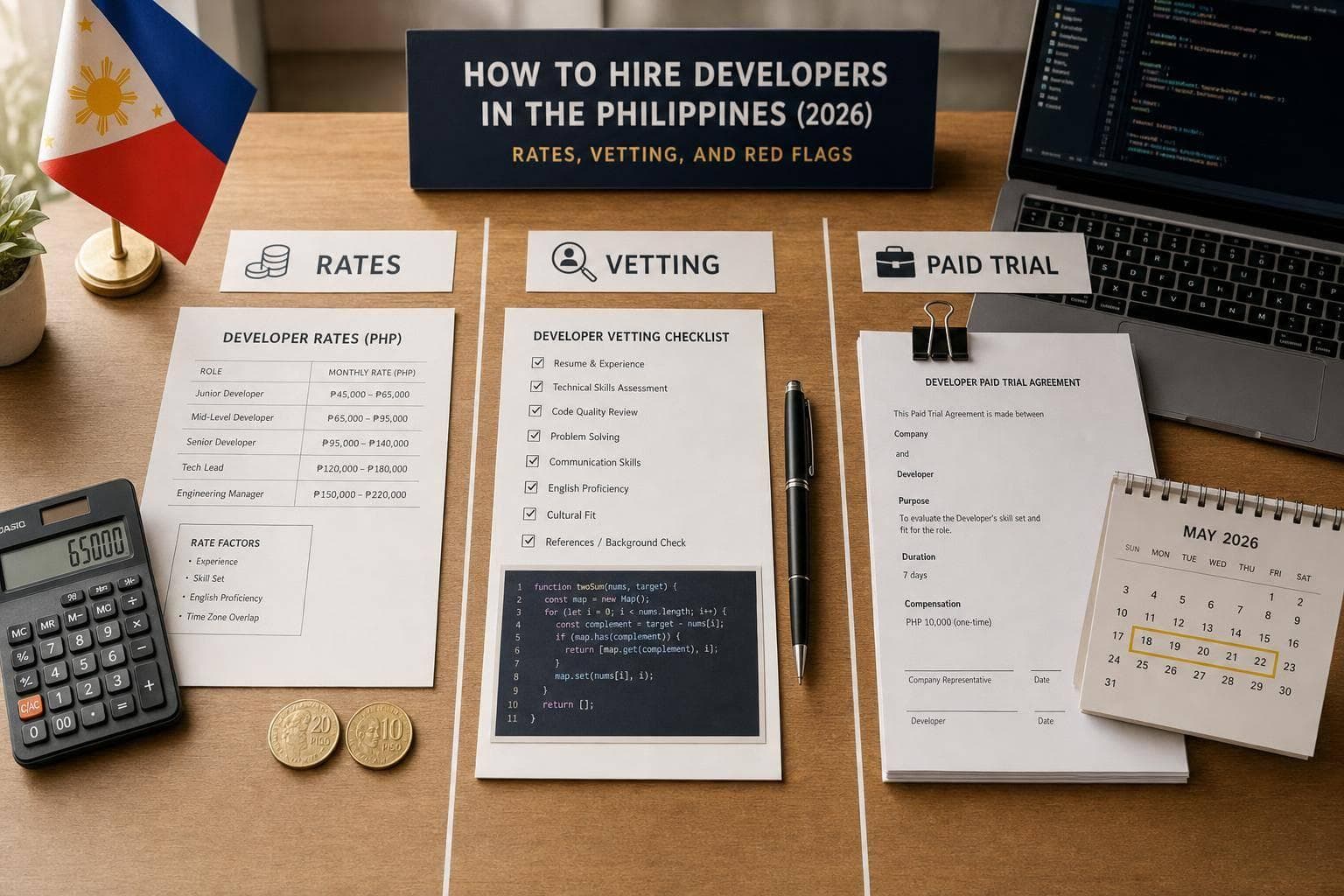
If I want to hire a developer in the Philippines in 2026, I need to get three things right: pay, screening, and remote fit. Most full-time direct-remote hires land around $1,400 to $6,000 per month, and U.S. companies often spend far less than they would for a similar U.S. hire. But low cost alone is not enough. If I skip skill checks, remote-work checks, or a paid trial, I can end up losing time and money.
Here’s the short version:
- Set pay by role and seniority. Frontend, backend, full-stack, mobile, QA, DevOps, and data roles do not price the same.
- Know the gap between local and foreign-remote pay. A developer paid by a Philippine company may earn much less than one hired direct by a U.S. company.
- Use monthly budgets for full-time hires. Hourly pricing fits project work better.
- Screen in steps. Resume, GitHub or portfolio, short written or video reply, paid test task, live interview, and references.
- Check remote setup early. Internet provider, backup connection, power backup, and Mac access for iOS work.
- Watch for warning signs. Inflated titles, fuzzy answers, weak code samples, odd GitHub activity, and refusal to do a scoped paid task.
- Do a paid trial. A 2- to 4-week trial with clear deliverables gives me better signal before a long-term commitment.
A few numbers matter up front:
- Junior developers: about $1,400 to $2,200/month
- Mid-level developers: about $2,000 to $3,500/month
- Senior developers: about $3,500 to $6,000/month
- Extra budget: add about 20% to 30% for tools, hardware, cloud use, and payment costs
- Local employment overhead: around 22% to 23% on top of wages if I hire through a local employer setup
Quick Comparison
| Area | What I should look for |
|---|---|
| Rates | Role, seniority, U.S. time overlap, direct-remote vs. local pay |
| Best pricing model | Monthly for full-time, hourly for project work |
| Skill checks | GitHub history, shipped projects, pair programming, paid task |
| Remote checks | English, async updates, ISP, backup internet, backup power |
| Top red flags | Vague project ownership, short stints with no reason, no tests, tutorial-only portfolio |
| Safer hiring move | Structured process plus paid trial before full offer |
The bottom line: I should budget at market rates, test for output instead of talk, and screen for remote dependability as hard as I screen for code. That is the simplest way to avoid a bad hire and make the cost savings work in practice.
sbb-itb-3690fed
1. 2026 developer rates in the Philippines
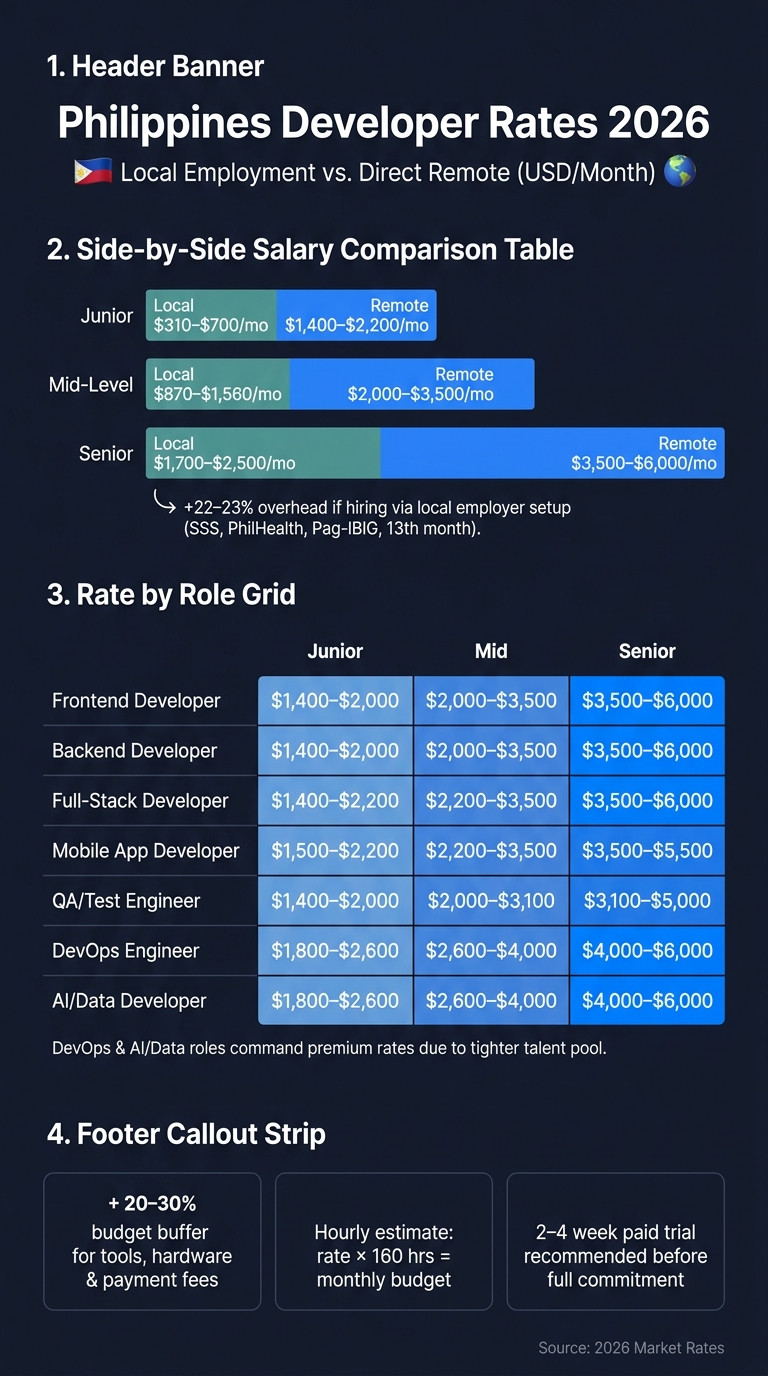
Philippines Developer Rates 2026: Local vs. Remote Pay by Role & Seniority
Start with the budget. In the Philippines, developer pay usually falls into two buckets: local salaries and direct-remote rates.
Rate ranges by role and seniority: frontend, backend, full-stack, mobile, QA, DevOps, and data
The ranges below reflect 2026 direct-remote market rates for Philippine developers. Frontend, backend, and full-stack roles usually land in the middle of the market. Mobile, DevOps, and AI/data roles tend to cost more because the talent pool is tighter.
| Role | Junior (Monthly) | Mid-Level (Monthly) | Senior (Monthly) |
|---|---|---|---|
| Frontend Developer | $1,400–$2,000 (~₱81,000–₱116,000) | $2,000–$3,500 (~₱116,000–₱203,000) | $3,500–$6,000 (~₱203,000–₱348,000) |
| Backend Developer | $1,400–$2,000 (~₱81,000–₱116,000) | $2,000–$3,500 (~₱116,000–₱203,000) | $3,500–$6,000 (~₱203,000–₱348,000) |
| Full-Stack Developer | $1,400–$2,200 (~₱81,000–₱128,000) | $2,200–$3,500 (~₱128,000–₱203,000) | $3,500–$6,000 (~₱203,000–₱348,000) |
| Mobile App Developer | $1,500–$2,200 (~₱87,000–₱128,000) | $2,200–$3,500 (~₱128,000–₱203,000) | $3,500–$5,500 (~₱203,000–₱319,000) |
| QA/Test Engineer | $1,400–$2,000 (~₱81,000–₱116,000) | $2,000–$3,100 (~₱116,000–₱180,000) | $3,100–$5,000 (~₱180,000–₱290,000) |
| DevOps Engineer | $1,800–$2,600 (~₱104,000–₱151,000) | $2,600–$4,000 (~₱151,000–₱232,000) | $4,000–$6,000 (~₱232,000–₱348,000) |
| AI/Data Developer | $1,800–$2,600 (~₱104,000–₱151,000) | $2,600–$4,000 (~₱151,000–₱232,000) | $4,000–$6,000 (~₱232,000–₱348,000) |
Use these ranges to set your top-end budget before you start screening candidates.
Local salary bands vs. direct remote pay from foreign employers
The difference between local and remote pay is large. A mid-level developer working for a Philippine company may earn about ₱50,000–₱90,000 per month (~$870–$1,560). That same developer, hired directly by a U.S. company as a remote worker, can often expect $2,000–$3,500 per month.
| Seniority | Local PH Pay (USD/month) | Remote Foreign Pay (USD/month) |
|---|---|---|
| Junior | $310–$700 (~₱18,000–₱40,000) | $1,400–$2,200 (~₱81,000–₱128,000) |
| Mid-Level | $870–$1,560 (~₱50,000–₱90,000) | $2,000–$3,500 (~₱116,000–₱203,000) |
| Senior | $1,700–$2,500 (~₱100,000–₱145,000) | $3,500–$6,000 (~₱203,000–₱348,000) |
Most foreign employers hire through a contractor setup or an EOR. If you hire through local employment, there are statutory costs on top of base pay: SSS, PhilHealth, Pag-IBIG, and 13th-month pay. Together, those add about 22%–23% to wages.
If you hire a developer directly as a contractor, those costs shift. That can change the math in your favor, but you still need to check that the setup does not create misclassification risk under both U.S. and Philippine rules.
Hourly vs. monthly budgeting for U.S. teams
Use monthly pricing for full-time roles. Use hourly pricing for project work or when workload moves up and down.
A simple way to estimate monthly cost is to multiply the hourly rate by 160 hours, which represents a standard 40-hour week across four weeks.
| Seniority | Hourly Rate (USD) | Monthly Budget at 160 hrs (USD) |
|---|---|---|
| Junior | $9–$13 | $1,440–$2,080 |
| Mid-Level | $13–$22 | $2,080–$3,520 |
| Senior | $22–$38 | $3,520–$6,080 |
On top of that, add 20%–30% for hardware, software, cloud spend, and payment fees. You may also need to pay more if the role requires overlap with U.S. work hours. Once your rate range is set, the next job is checking for skill and remote dependability.
2. Build a vetting process for remote developer hiring
Once your budget is set, the next step is figuring out who’s worth hiring. A clear screening process keeps you from picking someone just because they have a slick resume or interview well. In a remote setup, the main thing you’re trying to find is simple: can this person ship work reliably? Not just talk a good game.
Run candidates through a structured screening sequence
Start broad, then narrow things down. Each stage should answer one key question before you spend more time on the next one.
| Screening Stage | Purpose | Method | Mistakes to Avoid |
|---|---|---|---|
| 1. Resume & LinkedIn | Filter for core stack and experience level | Check stack match and remote experience | Focusing only on the lowest rate |
| 2. Portfolio/GitHub | Verify real-world application of skills | Review READMEs, commit history, and live project links | Accepting tutorial clones or single-commit repos |
| 3. Short video or written reply | Assess English fluency and response quality | Assess English fluency and response quality | Ignoring slow response times or vague answers |
| 4. Technical Trial | Prove ability to deliver scoped work | 4-hour paid task with defined acceptance criteria | Using tests unrelated to your stack |
| 5. Live Interview | Test problem-solving and remote readiness | 30-minute pair-programming session; ask about ISP and backup power | Failing to confirm Mac access for iOS roles |
| 6. References | Confirm reliability and dependability | Verify reliability with past employers or platform history | Skipping this step for candidates with strong profiles |
A 4-hour paid task with clear acceptance criteria will tell you far more than a resume ever can. You get to see how the person deals with unclear spots, shares progress, and reacts to feedback.
Review GitHub, portfolios, and coding tests for real proof of skill

Production work usually leaves a trail. You want to see clear READMEs, documented code, commit history that shows steady work, and signs that the person handled edge cases instead of just the happy path.
Shipped projects matter most. Look for work that was actually deployed and used, not just class projects or polished demo repos. During a technical screen, pay attention to whether the candidate asks clarifying questions. If they ask very few, that can point to weak problem analysis.
Once the portfolio checks out, move to work that feels close to the job itself. A 30-minute pair-programming session on an unfamiliar codebase often shows more than a resume ever will. You’ll see how the person reads code, thinks through trade-offs, and communicates under normal pressure.
For framework-specific roles, check for depth in the framework itself, not just the language behind it. Someone may know JavaScript and still struggle with production-level React work.
Evaluate remote readiness alongside technical ability
Technical skill is only half the job. If a developer can code well but struggles to communicate across time zones, your team will feel it fast. In remote teams, solid async habits make a big difference.
Look for signs like:
- written stand-ups
- Loom walkthroughs
- detailed pull request descriptions
- proactive updates when they hit a blocker
Internet reliability matters too. Don’t settle for “I have good internet.” Ask for the ISP name and the backup plan, whether that’s mobile data or a second ISP.
For iOS, React Native, or Flutter roles, confirm Mac access at the start. Xcode builds and App Store submissions depend on it, and there is no workaround.
These checks also help surface the red flags that tend to turn into costly mis-hires.
3. Red flags that lead to expensive mis-hires
Once your budget is set, the next job is simple: don’t spend it on the wrong person. A weak hire doesn’t just cost money. It burns time, slows delivery, and often sends you right back to the start of the search.
Resume and interview red flags to watch for
After you’ve set rates and built a vetting process, use these signs to filter out weak candidates sooner.
A polished resume proves very little. Look closely for inflated titles, buzzword-heavy descriptions, overlapping dates, short stints with no clear reason, and employers you can’t verify. In interviews, pay close attention to vague answers built around “we,” defensiveness when discussing mistakes, and trouble explaining a real production issue they’ve dealt with.
| Red flag | Why it matters | How to respond |
|---|---|---|
| "Senior" title with 2 years' experience | Likely mismatch between self-perception and expected autonomy | Ask about team size, decision-making, and specific ownership |
| Unclear or overlapping employment dates | May hide frequent switching or gaps | Request exact dates and reasons for each transition |
| Frequent short stints with no explanation | Can signal instability or shallow commitment | Ask what they were doing during each role and why they left |
| Unverified employers | Could indicate fabricated or misrepresented experience | Ask for a reference with a verifiable corporate email or LinkedIn profile |
| Buzzwords, no specifics | Suggests memorized language, not hands-on experience | Ask for trade-offs, constraints, and what they'd do differently |
| Only "we", never "I" | May signal limited involvement | Request a detailed walkthrough of one project they personally owned |
| Cannot explain their own code | Raises authorship concerns | Run a live walkthrough or ask them to modify a small piece on the spot |
One pattern shows up again and again: people who sound polished until you ask for specifics. That’s where the gaps start to show. If someone says they “led architecture,” ask what calls they made, what trade-offs they faced, and what they’d change now. If the answer stays fuzzy, that’s a bad sign.
Technical and remote-work red flags
A skill check alone won’t save you if the developer can’t do the job well from home.
On the technical side, the clearest warnings are refusal to complete a fair assessment, weak code quality like inconsistent naming, long messy functions, or obvious copy-paste blocks, and no sign of testing habits from candidates claiming mid-level or senior experience. Tutorial-only portfolios are shaky. So are GitHub profiles that look oddly perfect, or commit histories dumped into one or two days. For mid-level and senior candidates, missing unit or integration tests in their own projects is a strong red flag.
Repeated refusal or delay on a scoped test task usually points to weak skills or too much overload.
Remote-work checks matter too. Verify the ISP, backup plan, and Mac access for iOS roles. Ask for the ISP name, a speed test screenshot, and a backup plan. “I have good internet” doesn’t tell you much. Poor communication during interviews or async work is another warning sign, so look for clear written updates and thoughtful PR notes. For iOS roles, no Mac is an immediate disqualification because it is mandatory for Xcode builds and App Store submissions.
Hiring mistakes employers make when they focus only on low rates
Going after the lowest rate is one of the main reasons U.S. employers end up paying more later. The pattern is pretty predictable: they under-scope the role, skip verification to move fast, skip the trial period to save cash, then spend weeks managing a bad hire before starting the search all over again.
| Hiring mistake | Short-term savings | Long-term consequence | Better alternative |
|---|---|---|---|
| Under-scoping one cheap full-stack hire | Lower monthly payroll | Slower delivery, more bugs, burnout, eventual replacement | Define realistic scope; add a part-time specialist where needed |
| Skipping reference checks | Time saved in the process | Higher risk of mis-hire discovered only after onboarding | Run 2–3 structured reference calls focused on reliability and code quality |
| No paid trial | Avoids paying for a test period | Misaligned expectations found late; expensive termination and re-hire | Offer a clearly scoped 2–4 week paid trial with defined success criteria |
| Weak onboarding | Faster start | Hard to distinguish a bad hire from a badly supported one | Set 30/60/90-day goals, document the stack, and define a communication cadence |
Cheap hiring can get expensive fast. Saving a few dollars up front doesn’t help if delivery slows down, bugs pile up, or the team has to clean up avoidable messes.
Low rates don’t make up for weak screening. Use these failure patterns to tighten the workflow in the next step.
4. A repeatable hiring playbook for developer roles
Step-by-step hiring workflow for your next developer
Once you know what to screen for, make the process the same for every candidate. That way, each person goes through the same checks, and you're not making decisions on gut feel alone.
Use one repeatable hiring flow for every developer role. Start with a clear brief that spells out:
- tech stack
- seniority level
- core responsibilities
- required U.S. time overlap
Be specific about overlap. Set it in hours, not vague phrases like "some availability" or "flexible schedule."
After the role is clear, set your budget against 2026 market ranges before screening starts.
Then move every candidate through the same funnel: profile review, short communication screen, role-based coding test, technical interview, reference checks, and a paid trial with a fixed scope tied to actual deliverables. In most cases, that trial should run for two to four weeks, with clear success criteria set upfront. Price the trial as its own stage and connect payment to deliverables.
If your team doesn't have the time or internal bench to handle early screening, pre-vetted sourcing can speed up the first half of the process.
When pre-vetted sourcing can save time
Technical hiring can drag on for weeks, and senior roles often take even longer. FindTalent.ph can cut down the early work by surfacing verified Filipino developer profiles with identity checks, skills assessments, and portfolio reviews. If your team needs to hire fast or doesn't have in-house recruiting support, the recruiter-assisted option can deliver 1–3 vetted candidates within 5–7 business days for a flat $600 one-time fee, plus a replacement guarantee if the hire doesn't work out.
That said, pre-vetted sourcing isn't a substitute for your own vetting. It just shortens the early stages, so your team can spend more time where it matters most: final interviews, the paid trial, and the hiring decision.
Conclusion: Budget realistically, vet carefully, and hire for reliability
Three things usually decide whether a Filipino developer hire works: a competitive offer, a structured screening process, and a paid trial before any long-term commitment. Use 2026 rate benchmarks to make offers that pull in strong candidates, not just whoever happens to be on the market. Treat communication and remote readiness as core hiring criteria. If you spot red flags, act early before they turn into expensive onboarding problems.
Budget realistically, vet carefully, and use a paid trial before long-term commitment.
FAQs
How long does it usually take to hire a developer in the Philippines?
Usually, a developer who already knows your stack should start producing useful work within 1 to 2 weeks after kickoff, as long as they can get into your repos, staging setups, and have clear tasks to work on.
A good rule of thumb: plan for about a 2-week ramp-up, not 2 months. If the first pull request still isn’t merged after that, they may not be the right fit.
Should I hire a contractor or use a local employer setup?
If you want more predictable costs, tighter control, and fewer hiring hassles, go with a local employer setup instead of using an agency-based contractor model.
With direct hire on FindTalent, you set the developer’s rate and pay them directly. That means no agency markup and no long-term staffing contract hanging over the deal. You can also begin with a defined scope, then scale once the working relationship proves out.
If you bring on VAs as direct employees, plan to add 20%–25% to your budget for required benefits.
What should I include in a paid trial task?
Use a four-hour scoped task with clear acceptance criteria. Make it feel like actual work, not a tutorial.
That means the task should include:
- real data
- edge cases
- error states
Assess more than just whether the code runs. Look at:
- code quality
- documentation
- problem-solving
- communication
- how the candidate handles feedback
The goal is to see how they work in a production-oriented setting.