Remote Work
Ultimate Guide to Philippine Remote Work Trends 2026
How to hire Filipino remote talent in 2026: legal rules, cost, skills, time-zone fit, data safety, and practical screening tips.
10 min read

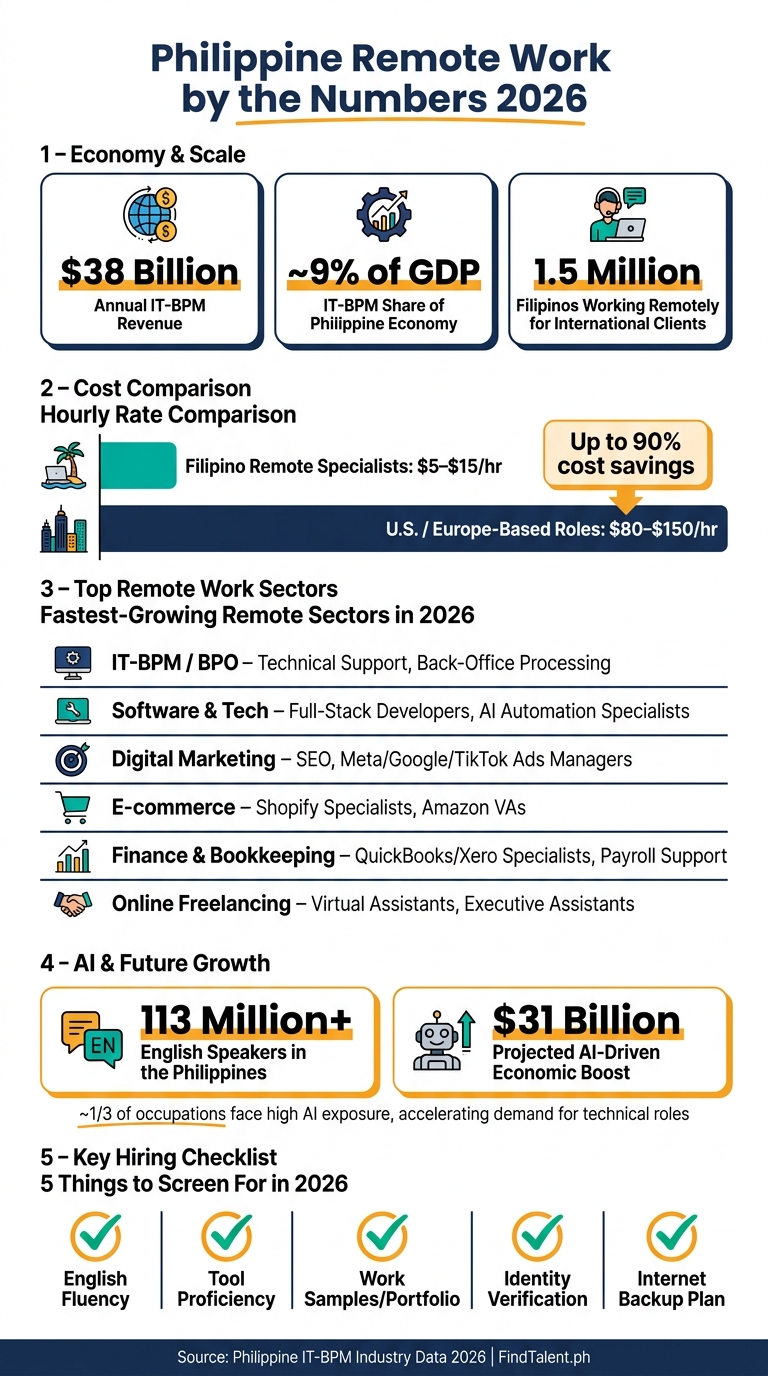
If I were hiring from the Philippines in 2026, I’d focus on five things first: legal setup, skills, time-zone fit, data safety, and proof of work. Remote work there is now a large part of the economy, with about $38 billion in yearly IT-BPM revenue, about 9% of GDP, and around 1.5 million Filipinos working online for foreign clients.
Here’s the short version:
- I’d treat remote work as a formal work setup, not a casual arrangement.
- I’d follow the Telecommuting Act, with written rules on pay, benefits, monitoring, and data safety.
- I’d look past Metro Manila, because hiring now reaches many other parts of the country.
- I’d expect more than VA and support roles. In 2026, demand is moving toward software, AI, automation, data, marketing, e-commerce, and bookkeeping.
- I’d screen for English skills, tool use, work samples, identity checks, and internet backup plans.
- I’d confirm shift overlap early, especially for U.S. business hours.
- I’d compare costs carefully: many Filipino remote workers charge about $5–$15 per hour, while similar U.S. or Europe-based roles may cost $80–$150 per hour.
What this means for you is simple: the Philippines still offers lower-cost remote hiring, but the best results come from clear rules, tight screening, and role-specific testing. You can collaborate with top-tier specialists through AI-powered search to streamline this process.
Quick comparison
| Area | What I’d know in 2026 |
|---|---|
| Legal rules | Remote work should be covered by a formal telecommuting policy |
| Top role shift | Growth is moving from admin work into AI, software, and data roles |
| Main sectors | IT-BPM, freelancing, digital marketing, e-commerce, finance, tech |
| Employer upside | Lower labor cost, strong English, and common use of remote tools |
| Main risks | Internet issues, data handling, weak screening, and poor fit |
| Best hiring checks | Portfolios, live calls, skills tests, KYC, and trial periods |
In short, I’d say 2026 is less about finding any remote worker in the Philippines and more about finding the right verified Filipino talent with the right setup, papers, and track record.
Philippine Remote Work by the Numbers 2026
Remotify: The Philippines has a once-in-a-generation chance to lead remote work | ANC
Businesses looking to capitalize on this shift can hire verified Filipino talent to scale their remote operations.
sbb-itb-3690fed
The Legal and Policy Rules Shaping Remote Work in the Philippines
Remote work in the Philippines is governed by law, not by a casual side agreement.
What the Telecommuting Act Requires
Republic Act No. 11165, the Telecommuting Act, says remote work must be voluntary, based on mutual agreement, and treated on par with onsite work. That means equal pay, benefits, rest periods, workload standards, and access to training.
Employer Obligations: Written Policies, Monitoring, and Data Protection
Employers need a written telecommuting program that spells out who is eligible, how performance will be measured, and what technical setup is required. Policies should also cover confidentiality and secure access.
In day-to-day work, remote teams often rely on digital tools for supervision and communication. The law does not name any one app or platform. What it does require is a clear system for monitoring work.
Comparison Table: Telecommuting vs. Onsite Employment in the Philippines
The table below shows how telecommuting differs from onsite work in practice.
| Factor | Telecommuting | Onsite Employment |
|---|---|---|
| Work Location | Employee's home or alternative site | Employer's premises |
| Primary Regulation | Republic Act No. 11165 (Telecommuting Act) | Philippine Labor Code |
| Supervision Method | Digital tools for remote monitoring and communication | Direct physical supervision |
| Data Security | Access controls, secure logins, and VPNs | Physical office security protocols |
| Time-Zone Flexibility | Often aligned to U.S., U.K., or Australian business hours | Standard Philippine business hours |
| Employee Protections | Equal pay, benefits, and workload as onsite staff | Full Labor Code protections |
With the legal floor in place, the next step is to look at how remote work is changing employment across the Philippine labor market.
Philippine Remote Work by the Numbers: Labor Market and Sector Growth
Employment, Underemployment, and the Move Toward Digital Work
The Philippine labor market offers a large English-speaking workforce, and remote work is turning that talent base into export income. With more than 113 million English speakers, the country is in a strong position to serve companies hiring from abroad.
But this isn’t just a story about volume. It’s also about the kind of work being done.
About one-third of occupations face high AI exposure, which is speeding up the push for technical upskilling and more specialized remote roles. That shift matters because the fastest-growing remote jobs now call for stronger technical skills, not just a reliable internet connection and open hours.
That demand is showing up most in a small group of sectors that now lead remote hiring.
IT-BPM, BPO, and Online Freelancing as Remote Work Drivers
The IT-BPM sector brings in about $38 billion a year and makes up nearly 9% of GDP. That alone gives it a central role in the country’s remote work economy.
Freelancing is another major growth driver. The Philippines is one of the fastest-growing freelance markets in the world. For overseas employers, that means a large pool of workers already used to remote systems, client work, and cross-border communication.
AI is adding another layer to that growth. Its adoption could add $31 billion to the economy, increasing demand for work tied to automation, chatbots, and AI content roles.
Comparison Table: Key Sectors Driving Remote Work in the Philippines
| Sector | Typical Remote Roles | Growth Indicators | SMB Value |
|---|---|---|---|
| IT-BPM / BPO | Call center agents, technical support, back-office processing | $38 billion annual revenue; nearly 9% of GDP | High |
| Software & Tech | Full-stack developers, WordPress specialists, mobile app developers, AI automation specialists | Fastest-growing segment in 2026; high demand for modern tool fluency (Zapier, OpenAI APIs) | High |
| Online Freelancing | Virtual assistants, executive assistants, data entry specialists | One of the fastest-growing freelance markets globally | High |
| Digital Marketing | SEO specialists, Meta/Google/TikTok ads managers, digital marketing specialists | High demand driven by SMBs in the U.S., Australia, and the U.K. | High |
| E-commerce | Shopify specialists, Amazon VAs, inventory managers | Driven by projected $66.35 billion retail market growth between 2024 and 2028 | High |
| Finance & Bookkeeping | Bookkeepers, QuickBooks/Xero specialists, payroll support | Steady demand; core category for SMB outsourcing | High |
These sector trends help explain why so many overseas employers look to the Philippines for remote hiring. The mix covers support, tech, marketing, e-commerce, and finance, which gives small and midsize businesses access to talent across many day-to-day functions.
Economic Impact and Hiring Considerations for Overseas Businesses
How Remote Work Expands Income, Participation, and Regional Access
Remote work now links Filipino professionals with employers around the world. About 1.5 million Filipinos work remotely for international clients, with most serving companies in the U.S., Australia, and the UK.
That shift is opening remote-job access far beyond Metro Manila. It also lowers the barrier for skilled workers in other regions to compete for global roles. For overseas employers, that larger talent pool matters even more when hiring needs are urgent and skills need to be checked fast.
What U.S.-Based SMBs Gain From Hiring Filipino Remote Professionals
For U.S. small and midsize businesses, the draw is pretty simple: English-fluent talent at a lower cost than hiring in the U.S.
Filipino specialists often charge $5 to $15 per hour, compared with $80 to $150 per hour for similar roles based in the U.S. or Europe. Many also already use common remote-work tools like Slack, Asana, and Google Workspace. On top of that, a lot of Filipino professionals are used to U.S. business hours because of the country's BPO sector.
That makes them a strong fit for roles such as:
- Virtual assistance
- Customer support
- Bookkeeping
- Digital marketing
- Web development
- Data analytics
This is where screening can make or break the hire. Move too fast, and cheap can get expensive.
FindTalent.ph uses AI matching, identity verification, and skills testing to help businesses find pre-screened Filipino specialists.
Comparison Table: Benefits and Risks of Hiring Remote Talent From the Philippines
The upside is clear, but there are still a few practical risks to watch.
| Factor | What to Expect | Mitigation Step |
|---|---|---|
| Cost efficiency | Filipino specialists typically charge $5–$15/hr versus $80–$150/hr for similar U.S. or Europe-based roles | Compare total cost, including platform fees and payment processing |
| Time zone coverage | Many professionals are accustomed to U.S. hours because of BPO work, and overnight shifts are common | Confirm shift availability upfront |
| English fluency & communication | Strong written and verbal English proficiency is a major advantage | Use a short live call during screening to assess pace and clarity |
| Internet & power continuity | Connectivity and power interruptions still disrupt some home offices | Ask candidates to show their home office setup and backup plan |
| Data security | Roles involving sensitive data require careful handling and confidentiality | Conduct reference checks and favor candidates with sensitive-data experience |
| Credential verification | Skills can be overstated | Use platforms with KYC checks and built-in skills testing |
| Retention and fit | A poor match increases turnover risk | Start with a 30-day trial and clear weekly deliverables |
The next step is to choose remote talent against clear requirements for skills, time-zone coverage, and compliance.
How to Act on These Trends in 2026
What to Look for When Hiring Filipino Remote Talent in 2026
Remote work has grown up a bit. Hiring in 2026 is less about who's available and more about who can show results.
That means proof matters more than resumes. Global employers want portfolios, measurable outcomes, and signs that a candidate can work with AI in a practical way, not just a list of tools they claim to know.
When you review candidates, focus on a few things that tend to tell the truth fast:
- Clear, fluent communication
- Examples of initiative taken without being asked
- Comfort with common collaboration and CRM tools
- For technical roles, GitHub commit histories and pull requests instead of just solo project links
- Exact time-zone overlap written into the contract when needed, such as 12:00 PM–9:00 PM PHT for U.S. Pacific mornings
You should also screen for hands-on AI use. Look for prompts, automation, and AI-assisted output, not vague familiarity.
How FindTalent.ph Supports Faster, More Structured Hiring
The fastest way to respond to these trends is simple: tighten your screening process and cut down manual sorting.
A lot of hiring delays come from digging through unverified profiles. FindTalent.ph tackles that with AI matching based on your job brief, helping surface verified specialists from a pool of over 3,000 screened Filipino professionals across 120+ job titles.
Each specialist goes through identity checks and profile review before showing up in search results. Pricing is fixed and transparent, with rates based on seniority and specialization.
Conclusion: Philippine Remote Work Trends Businesses Should Watch in 2026
In 2026, the clearest hiring signals are practical: AI literacy, strong communication, verified identities, tool fluency, and time-zone fit.
To cut risk, use clear briefs, ask for real work samples, set fixed overlap windows, and use a 30-day trial with weekly deliverables.
FAQs
Do I need a formal remote work policy to hire from the Philippines?
No. You are not legally required to have a formal company-wide remote work policy.
That said, clear written agreements are a smart move. Before work starts, spell out the scope of work, payment schedule, intellectual property ownership, and termination terms. It saves headaches later.
If you bring someone on as a direct employee instead of an independent contractor, Philippine labor laws require benefits such as 13th-month pay, SSS, PhilHealth, and Pag-IBIG.
Which remote roles in the Philippines are growing fastest in 2026?
In 2026, the fastest-growing remote roles in the Philippines are software development and AI-related jobs. That includes work like automation specialists and chatbot developers.
Customer support and admin roles still make up the biggest share of remote work. But the market is moving fast toward technical positions, especially jobs tied to tools like Zapier, Make, and OpenAI's APIs.
How can I verify a Filipino remote worker before hiring?
Prioritize platforms with multi-step verification. On FindTalent.ph, specialists go through identity checks, portfolio reviews, and skills assessments before appearing on the platform.
You can also review portfolios for measurable results, request a short voice or video introduction to gauge communication, check relevant certifications, and start with a 30-day trial period with clear weekly deliverables.